
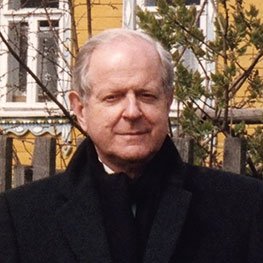
Robert Conquest
Robert Conquest was born in Malvern, Worcestershire, in 1917, to an American father and his English wife. Educated at Winchester College, the University of Grenoble, and Magdalen College, Oxford, he took his B.A. and (later) M.A. degrees in politics, philosophy, and economics, and his D. Litt. in Soviet history.
In Lisbon on an American passport at the outbreak of the Second World War, he returned to England to serve in the Oxfordshire and Buckinghamshire Light Infantry, and in 1944 was sent from Italy on Balkan military missions awkwardly attached to the Soviet Third Ukrainian Front – and later the Allied Control Commission in Bulgaria. From 1946 to 1956, he worked in the British Foreign Service – first in Sofia, then in London, and in the U.K. Delegation to the United Nations – after which he varied periods of freelance writing with academic appointments.
Conquest’s poems were published in various periodicals from 1937. In 1945 the PEN Brazil Prize for a war poem was awarded to his “For the Death of a Poet” – about an army friend, the poet Drummond Allison, killed in Italy (published in The Book of the PEN 1950) – and in 1951 he received a Festival of Britain verse prize. Since then he has brought out nine volumes of poetry previous to Blokelore & Blokesongs, and one of literary criticism (The Abomination of Moab). He published a verse translation of Aleksandr Solzhenitsyn’s epic Prussian Nights (1977), and two novels, A World of Difference (1955), and (with Kingsley Amis) The Egyptologists (1965). In 1955 and 1963 Conquest edited the influential New Lines anthologies, and in 1962-1963 he was literary editor of the London Spectator.
He was the author of twenty-one books on Soviet history, political philosophy, and international affairs, the most recent being The Dragons of Expectation (2004). His classic, The Great Terror, has appeared in most European languages, as well as in Japanese, Arabic, Hebrew and Turkish.
In 1959-60 he was Visiting Poet and Lecturer in English at the University of Buffalo. He also held research appointments at the London School of Economics, the Columbia University Russian Institute, the Woodrow Wilson International Center for Scholars, the Heritage Foundation, and Harvard University’s Ukrainian Research Institute.
In 1990 he presented Granada Television’s Red Empire, a seven-part documentary on the Soviet Union which was broadcast in the UK, the USA, and in various other countries, including Australia and Russia.
Conquest was a Fellow of the British Academy, the American Academy of Arts and Sciences, the Royal Society of Literature, and the British Interplanetary Society; he was also a member of the Society for the Promotion of Roman Studies (contributing to Britannia an article on the Roman Place Names of Scotland). His honours and awards included the Presidential Medal of Freedom; the Companion of the Order of St. Michael and St. George; the Order of the British Empire; the Commander Cross of the Order of Merit of the Republic of Poland; the Ukrainian Order of Yaroslav Mudryi; the Estonian Cross of Terra Mariana Order of Merit; the Jefferson Lectureship; the American Academy of Arts and Letters’ Michael Braude Award for Light Verse; the Richard Weaver Award for Scholarly Letters; the Fondazione Liberal Career Award; and the Dan David Prize.
He lived with his wife Elizabeth in California, where he worked as a research fellow at Stanford University’s Hoover Institution. He died in 2015, aged 98.
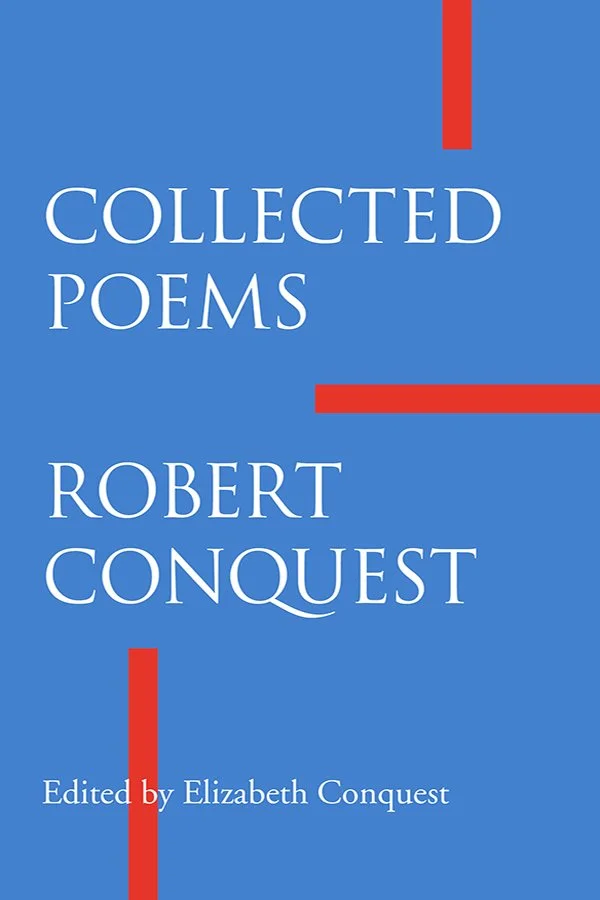
Collected Poems
by Robert Conquest
Editor's Note by Elizabeth Conquest
This volume brings together eight decades of work by a writer described in the Dictionary of National Biography as “a man of letters, attaining equal distinction as poet, historian, and political commentator.” Robert Conquest’s many honours include the PEN Brazil Prize (for the best long poem about the Second World War), a Festival of Britain verse prize, and the Michael Braude Award for Light Verse. His poems cover an astonishing range: Clive James praised his “fastidiously chiselled poems which proved his point that cool reason was not necessarily lyricism’s enemy”, while Philip Larkin, applauding Conquest’s virtuosity with the limerick form, inscribed a copy of High Windows “To Bob, il miglior fabbro (or whatever it was) – at least over five lines.” Conquest neatly skewered pretension wherever he found it, but throughout his long life also wrote eloquent poems of love, longing, and loss. As the poet and critic David Mason has observed, These are poems by a man of the world who has seen and studied much and has apparently lived with gusto. It is good to be in his company.
Witty. Energetic. Tender.
Pub. Mar. 15, 2020
What People Are Saying
“All Conquest’s strengths are evident here – wit, love of life, ferocious technique, and the infinite taking of pains.”
— Martin Amis
“Much of Conquest’s best-known poetry is funny, even absurdly hilarious, but when it is serious it is continuous with the voice that wrote on history and politics.”
– Dick Davis, The Hopkins Review
“A strong and individual voice talking about things that matter … hard energetic movement … lucidity and power.
– Thom Gunn, The Spectator
“Only a first-rate poet could have written stanzas of such deceptive lightness and ease.”
– Selina Hastings
“[Conquest’s] virtues – precision, wit, craftsmanship – only seem old fashioned to those who believe poetry can do without them. For others, this book will be a continual reminder of times when poetry was turned to in the sure and certain hope of pleasure and instruction.”
– Alan Jenkins
“Among the most original short pieces to be published in recent years … remarkable in their combination of lyrical rhetoric and delicate observation.”
– The Times Literary Supplement
“These are poems by a man of the world who has seen and studied much and has apparently lived with gusto. It is good to be in his company.”
– David Mason
“These vigorous poems have an exquisite colour sense …They linger wittily over longing … They are irreverent to the cosmos … and, with a nod to Larkin, savage to biographers.”
— Alison Brackenbury, Poetry Review
“In poems about love, the subversive, lyrical proof that desire goes on into old age is alive in every cadence and perception. As ever, he makes many a younger writer look short of energy.”
– Clive James
“The poems … are smart, funny, tough-minded, generous, and utterly individual.”
– Zachary Leader
“A fully developed and impressive style … he writes with clarity, authority and cunning.”
– New York Times Book Review
“Conquest’s red-blooded approach to Eros in these poems refreshes rather than repels. For someone critics have accused of blokishness, Conquest writes with great subtlety and often with great tenderness.”
– David Yezzi, The New Criterion
Five Poems from Collected Poems
Goethe in 1816
Sunlight breaks dazzling from the stream
But he is not deceived,
Nor when the young breeze shakes that gleam
From trees gone golden-leaved.
But as he turns, with eyes undimmed
To watch that warm sun sink,
A young shape, deep-eyed, golden-limbed
Stands poised upon a brink.
Declension into saint or sage
Is not worth thinking of:
Into the cold pool of his age
She dives and brings up love.
copyright, The Estate of Robert Conquest
My Demands Upon Life Are Quite Modest
My demands upon life are quite modest:
They’re just to be properly goddessed.
Astarte or Isis
Would do in a crisis,
But the best’s Aphrodite, unbodiced.
copyright, The Estate of Robert Conquest
Afterwards
“recollected in tranquillity”
Is it so necessary
For a wild memory
To fade and blur
Before the full charge
Of an old love or rage
Can really register?
With a life’s long perspectives
The changed picture gives
More depth and scope
As twisted faces shrink
To little more than pink
Blobs on its landscape …
A passion, sharp and hot,
Might once have seized the heart
To rip or scald.
So far as this can be
Recalled in tranquillity
It’s not recalled.
copyright, The Estate of Robert Conquest
There Was a Great Marxist Called Lenin
There was a great Marxist called Lenin,
Who did two or three million men in;
That’s a lot to have done in
But where he did one in
That grand Marxist Stalin did ten in.
copyright, The Estate of Robert Conquest
Seven Ages: First Puking and Mewling
Seven Ages: first puking and mewling;
Then very pissed off with one’s schooling;
Then fucks; and then fights;
Then judging chaps’ rights;
Then sitting in slippers; then drooling.
copyright, The Estate of Robert Conquest