

Philip Hoy
Philip Hoy was born in London in 1952, and educated at the Universities of York and Leeds. He has a Ph.D in Philosophy, a subject he taught most recently for the University of Oxford’s Department for Continuing Education. Prior to founding The Waywiser Press, he co-founded (with Peter Dale and Ian Hamilton) Between The Lines, now an imprint of Waywiser, which is devoted to publishing book-length interviews with contemporary poets.
Recent publications include Joseph Conrad on the Merchant Service’s War Effort (1918): A First Publication Discovered (The Conradian, 44:1, spring 2019), A Bountiful Harvest: The Correspondence of Anthony Hecht and William L. MacDonald (Waywiser, 2018), and “The Transatlantic Disconnect”, which is a modified version of the paper he delivered at the AWP conference in Boston, Massachusetts in March 2013, where his fellow panellists were Adam Kirsch, Eric McHenry, Mary Jo Salter and Rosanna Warren (The Warwick Review, September 2013). Previous publications include W.D. Snodgrass in Conversation with Philip Hoy (Between The Lines, London, 1998), Anthony Hecht in Conversation with Philip Hoy (Between The Lines, London, 1999, 2001), and Donald Justice in Conversation with Philip Hoy (Between The Lines, London, 2001). A fine press edition of Anthony’s Hecht’s last poems, Interior Skies, for which Hoy wrote the foreword, was published in 2011 by Liv Rockefeller and Kenneth Shure’s Two Ponds Press. An interview with Hoy concerning Between The Lines was published in The Dark Horse: “The Interviewer Interviewed: N.S Thompson talks to Philip Hoy, Editor of Between The Lines”, The Dark Horse, 15, Summer 2003: 40-46. This interview can be read on-line.
Hoy’s M. Degas Steps Out, a 15,000 word, amply illustrated essay about the only bit of film footage we have of the artist Edgar Degas — an essay described by Julian Barnes as A fascinating forensic study and a scholarly tour de force — was published by Waywiser in the autumn of 2022. And in 2023, the centenary year of the poet’s birth, a one-volume edition of Anthony Hecht’s Collected Poems of which Hoy is the editor will be published in the USA by Knopf.
On March 21st 2023, Hoy and the American poet, critic and editor Stephen Yenser were interviewed online by Poetry East’s Maitreyabandhu, with Hoy talking about Anthony Hecht’s “The Venetian Vespers” and Yenser talking about James Merrill’s “The Book of Ephraim”. The event, which runs to two hours and 15 minutes, can be watched on YouTube at: Philip Hoy and Stephen Yenser in Conversation
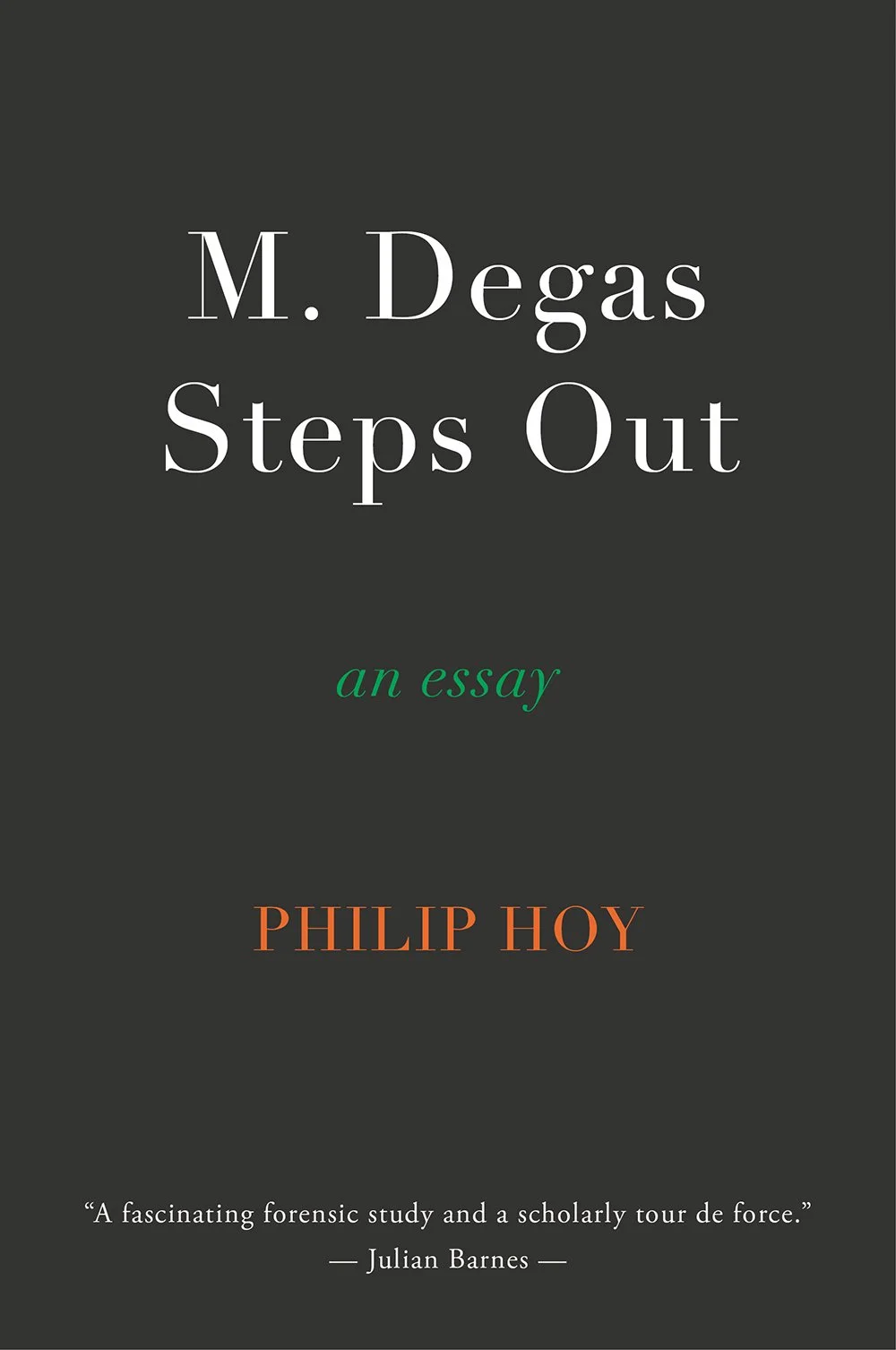
M. Degas Steps Out
by Philip Hoy
Pub: Oct. 7, 2022
In the autumn of 2011, I went to see Degas and the Ballet, an exhibition which had recently opened at the Royal Academy in London’s Piccadilly. Long an admirer of Degas’s art, I cherished this opportunity to see so many of his works – not far short of one hundred paintings, sculptures, pastels, drawings, and prints, as well as a number of the photographs he had taken in his later years. Although the exhibition was everything I could have hoped for, and more, my most vivid memory is not of the works on display, but of a grainy sequence of black and white film which was being shown in the exhibition’s last room. The sequence was very short, running for a mere nine seconds, but it was being played on a continuous loop, and I sat and watched it again and again, totally mesmerized. A notice to one side explained that the central figure in the sequence – a bowler-hatted man walking along a busy Parisian street, accompanied by a much younger woman – was the artist whose exhibition we had just visited. I don’t recall if it said anything else.
Thus begins M. Degas Steps Out, Philip Hoy’s painstakingly researched, engagingly written, and thought-provoking essay, an essay in which he not only tells us how this fugitive bit of film came to be made but also seeks to correct mistakes about it which have entered the accounts of earlier commentators – biographers, art historians, even the film-maker himself. Then, in a fine postscript, Hoy addresses himself to the question of what it is about this film that is so captivating, enticing us to watch it not just once or twice, but repeatedly.
-
“A fascinating forensic essay, and a scholarly tour de force. — Julian Barnes
“Philip Hoy’s writing is excellent, his sleuthing persuasive, and his conclusion packs a punch. M. Degas Steps Out is likely to be of no little interest to Degas scholars and aficionados.”— Neil Berry
“What a wonderful piece of work! I can’t say how much I loved this utterly original book. The author looks long and hard at nine seconds of pedestrian film much as a good art historian looks at a great painting, and by truly interrogating it — analysing every gesture, every glance, every turn of the head — he succeeds in transforming each of the many anonymous figures we see into a person with a past, a future, a profession, an interest. The complexity of it all is mind-expanding. M. Degas Steps Out is the best thing I’ve read in years.” — Richard Dorment
“Philip Hoy’s protracted examination of a mere nine seconds of film of the aged Edgar Degas walking towards us down a Paris street has the effect of waking us up to the utter strangeness of human life and of the mysterious power of photography and film. Haunting.” — Gabriel Josipovici, Emeritus Professor of English, University of Sussex
“Delicious … Beautifully written.” — Phillip Lopate
“A truly remarkable piece of work, this beautifully written essay proves to be as affecting as it is enthralling. Hoy is best known as a publisher and editor, but in these pages he steps out as an equally brilliant author. M. Degas Steps Out deserves to find a wide readership.” — Jonathan Post, Distinguished Research Professor of English, University of California, Los Angeles
“Philip Hoy fully justifies spending so many pages on a mere 9 seconds of historical event. An exemplary piece of forensic research becomes, through his handling of it, an utterly absorbing story.” — Christopher Reid
“I haven’t read a stranger, more original book in a very long time. It’s a wonder. I suspect that M. Degas, lover of privacy that he was, would have been delighted by the book, which it’s an understatement to call an ‘essay’.”— Sherod Santos, Emeritus Professor of English, University of Missouri
“An engrossing treat: Philip Hoy’s M. Degas Steps Out examines a short illicit film of Degas in his old age and turns it into an absorbing quest.” — Miranda Seymour
“What a superb essay — a thrilling page turner and a powerfully moving memento mori. I love Hoy’s patient attention to detail, the way he looks, then looks again, and in describing what he sees dramatizes as vitally as possible the pastness of the past, its vanishing immediacy. A fabulous and riveting piece.” — Alan Shapiro, William R. Kenan, Jr. Distinguished Professor of English and Creative Writing, University of North Carolina at Chapel Hill
“M. Degas Steps Out is a triumph of patience and perseverance, observation and speculation, research and imagination, in an ekphrastic genre that as far as I know Philip Hoy has invented. His profound meditation involves exegeses of stills from a nine-second silent, black-and-white film of an aging Edgar Degas taking the air on a Parisian Boulevard. Hoy’s animation of these stills conjures another dimension altogether from that of the ‘movie.’ It makes one think now of Sebald, now of Proust.” — Stephen Yenser, Distinguished Research Professor of English, University of California, Los Angeles
-
The Observer (January 29, 2023)
Bianca Stigter’s recent documentary Three Minutes: A Lengthening is based on a short home movie taken by an American tourist in the Polish town of Nasielsk in 1938. The same section of film appears again and again, accompanied by commentary and testimonies, slowed down, zoomed in on and freeze-framed. Yet these everyday images of Jewish life acquire an extraordinary poignancy because we know that almost everyone on screen will soon be caught up and killed in the Holocaust … Something of the same spirit pervades Philip Hoy’s striking essay-length book M. Degas Steps Out. When he went to an exhibition of Edgar Degas in 2011, he became ‘totally mesmerised’ by a nine-second film clip of the ageing painter walking down a Paris street. So he downloaded it on to his computer, slowed it down and broke it up into 250 stills, 42 of which are included here … By subjecting this tiny sequence to intense analysis, Hoy shows how it reflects a tragic turning point in French life. Early in the first world war, the actor and playwright Sacha Guitry put together a short propaganda film showcasing leading figures in French culture. Friends such as Sarah Bernhardt and Claude Monet were happy to perform for the camera, but when Degas grumpily spurned his approaches Guitry was obliged to film him surreptitiously … When we realise we are looking at wartime Paris, Hoy suggests, we start to notice the absences. The city has been ‘feminised’, with more women than men out and about. Only a soldier and one other man appear to be of military age. And the once busy streets are now empty of traffic, since most vehicles were requisitioned by the army … But what about the unknown figures glimpsed momentarily and then lost for ever? Could the soldier be one of the tiny minority stationed in Paris or granted a short period of leave – and was he among the 1.4 million French people who perished in the war? Could the four women in ankle-length outfits be entertainers, Hoy wonders, or perhaps some of the city’s 6,000 registered sex workers coming home from ‘Leave Land’, near the Gare du Nord, which, according to one historian, would shortly witness ‘an explosion in open-air sex’? Why is the gawping young man on a triporteur or delivery tricycle not away at the front? And what, if anything, can we read into an ephemeral glance? … Although he has clearly read widely on the social history of Paris, Hoy admits that much of his essay amounts to ‘idle speculation’ but he has certainly woven a beguiling tapestry around it. Matthew Reisz
To read the whole of this review, go to: https://www.theguardian.com/books/2023/jan/29/m-degas-steps-out-an-essay-by-philip-hoy-review-an-artistic-encounter-across-a-century
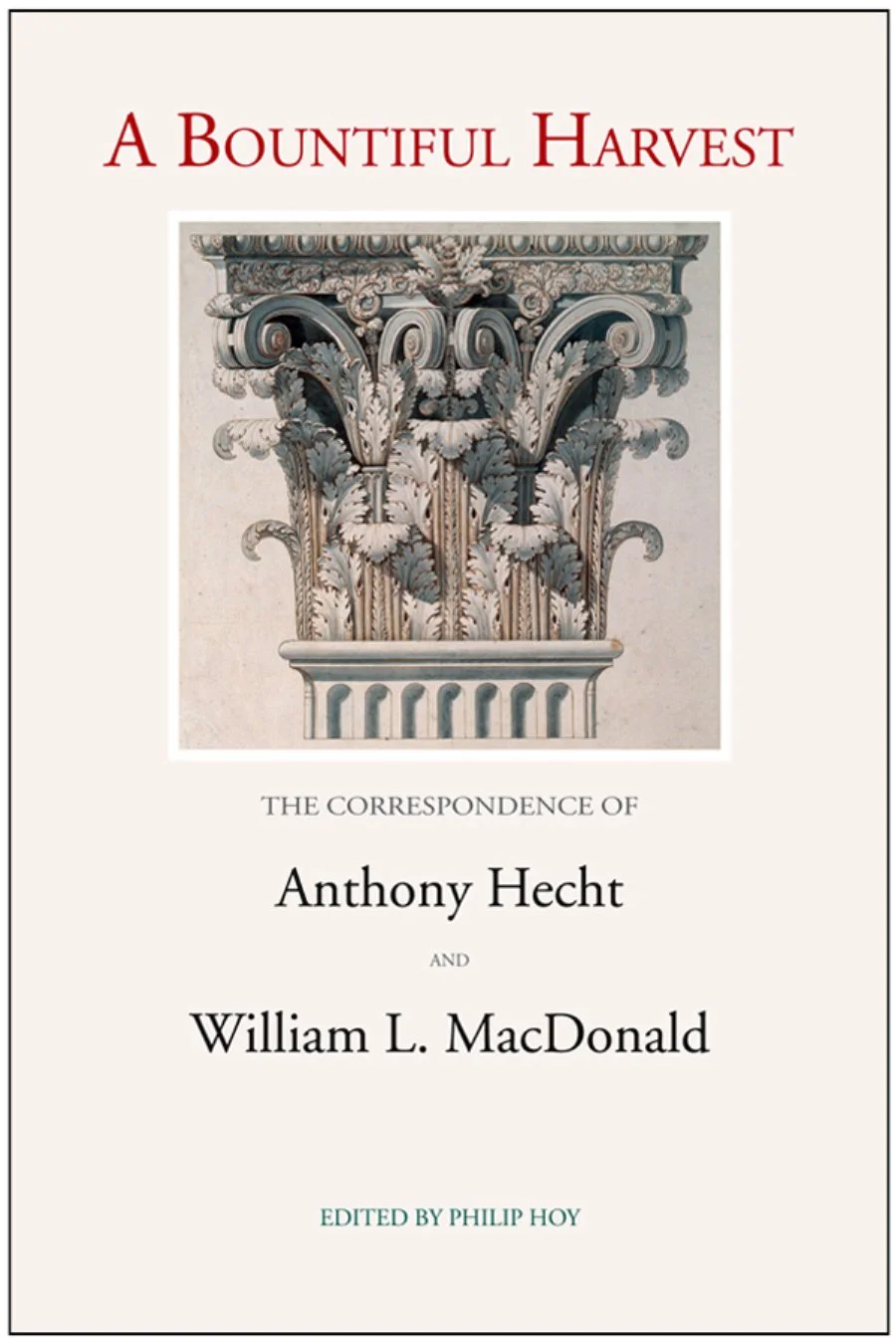
A Bountiful Harvest
edited by Phil Hoy
Pub: Mar. 15, 2018
Anthony Hecht and William L. MacDonald met for the first time in the fall of 1954, shortly after each had arrived in Rome, Hecht on a Guggenheim Fellowship, and MacDonald on a Rome Fellowship at the American Academy. Hecht was 31 years old, and MacDonald 33; both were recently married, and both were on their way to making names for themselves, Hecht as one of his era’s most esteemed poets, and MacDonald as one its most accomplished architectural historians. Though neither man could have realized it at the time, this was to be the start of a friendship that would endure for the best part of four decades, a friendship which would generate a large body of correspondence, the character of which is likely to come as a surprise to anyone who only knew the men by their works. All but a handful of the 440 letters and postcards that have come down to us are now gathered in A Bountiful Harvest, a volume edited and with an introduction by Anthony Hecht’s UK publisher Philip Hoy. The correspondence combines richness of anecdote with variety of topic, lightness of touch with great learning, a passion for high culture with a love of the down-to-earth and downright off-colour, concern for each other with undisguised rivalrousness. Above all, the exchanges are almost unceasingly funny, except towards the end, when things take an unexpected and deeply saddening turn.
-
“This is a unique and exhilarating yield indeed, a decades-long epistolary exchange between two of late twentieth-century America’s wittiest and most creative minds, inventing as they go a parlance (mostly English, with much exotic admixture) at once deeply learned and wickedly ribald, parodically arch and touchingly percipient. More often than not the points of departure are the visual arts, architecture, and literature, and other subjects include extravagant ‘lagniappes of culture,’ while in counterpoint we have Philip Hoy’s energetic, resourceful exactitude. His curiosity shines its light into every nook and cranny — crook and nanny, as one under the pertinent influence might say — and indeed there are moments at which the reader suspects the editor is participating in the game he broadcasts. His scrupulous notes about their stationery dovetail with the correspondents’ ingenious allonyms, and his carefully chosen photos and other visual aids provide welcome context. Turn to this book at any point for spiritual stimulation—as inspiration for an essay on the classical, the romantic, or the baroque, as an antidote to academic ennui, as a livre de chevet—and be gratified and thankful.”— Stephen Yenser, University of California, Los Angeles, author of The Consuming Myth: The Work of James Merrill, and co-editor of the Selected Letters of James Merrill
“In the elegance, gravity, and genius of Anthony Hecht’s poetry, we sometimes catch a spirit of repartee – the same spirit that animates so much of the correspondence in this volume. In each letter Hecht exchanged with the Roman architectural historian William L. MacDonald, we follow the chase of wit from salutation to subscription. Philip Hoy’s graceful and discerning practice as editor achieves his sought-after ‘Accuracy / Relevance / Concision / Interest,’ illuminating their minds at work and play on the page.” — Saskia Hamilton, Barnard College, editor of The Letters of Robert Lowell, and co-editor (with Thomas Travisano) of Words in Air: The Complete Correspondence Between Elizabeth Bishop and Robert Lowell
“Robert Frost said he entertained ideas only to see if they entertained him. Hecht and MacDonald devote all their energies to entertaining each other. They sign off letters by the likes of Sir Cairo Portcullis, or Eddie Puss, or Timon of Akron, or Engle & Bert Humperdinck. They revel in shared feelings of contempt for a mutually disliked colleague, ‘The great arch-fool and world’s leading nitwit.’ Hecht offers to provide ‘filthy pictures’ for MacDonald’s book on Russian cities and does so under the name Jeremy Bentham. For these two close friends, every letter was a chance to perform in strikingly amusing ways. Now we can share in these entertaining performances.” — William Pritchard, Amherst College, author of Updike: America’s Man of Letters, and Frost: A Literary Life
“Reading the correspondence of poet Anthony Hecht and architectural historian William L. MacDonald is like listening in on an extended, intimate, learned, and always entertaining conversation between two extraordinary men — witty raconteurs, brilliant intellectuals and incisive wordsmiths — as they explore their interior lives, comment on friends and events, and return, again and again, to the tribulations and joys of their creative work.” — John Pinto, Princeton University, author of The Trevi Fountain, and co-author of Pietro Bracci and Eighteenth-Century Rome: Drawings for Architecture and Sculpture in the Canadian Center for Architecture and Other Collections
“These letters between two old friends, each a master of his craft, are a delight. They are full of wit and high spirits, and shot through with Rabelaisian humor. Along the way, we learn a good deal about architecture and enjoy a feast of literary gossip, as well as recondite bits of lore. Such gifts for a reader are rare.” — Eleanor Cook, University of Toronto, author of Elizabeth Bishop at Work, and A Reader’s Guide to Wallace Stevens
“It is rare to find a pair of writers with such exhilarating flair for the epistolary sport as Hecht and MacDonald. Still rarer is it for letters to find so judicious and resourceful an editor as Philip Hoy. I am reminded of a great Wimbledon final. The players have all the shots, and the umpire never misses a call.” — Jonathan Post, Distinguished Professor of English, University of California, Los Angeles, author of A Thickness of Particulars: The Poetry of Anthony Hecht, and editor of The Selected Letters of Anthony Hecht
“In their rapid shifts between intimacy, reflection, verbal wit, playful impersonations, and satirical sketches, their moving acts of memory and sharp notes on human foibles, these letters offer a fascinating map of two minds, one a great American poet and the other an important scholar of ancient architecture. Along with a sense of beauty, a strong, often dark sense of history, a vital sense of inherited culture, marks both writers, and it’s perhaps no accident that thoughts of Rome, city of ruins and reconstructions, so often link the two in their letters.” — Kenneth Gross, University of Rochester, author of The Dream of the Moving Statue, and Shakespeare’s Noise
“A Bountiful Harvest is mesmerizing. Once I opened its pages I read it voraciously. It is also a beautifully produced volume.” — Helen Searing, Alice Pratt Brown Professor Emerita of Art, Smith College
-
Essays in Criticism (68:4,October 2018)
These [403] letters and postcards exchanged between Anthony Hecht and William O. MacDonald over the course of roughly three decades constitute a dazzling instance of epistolary wit by two experts in the genre: Hecht, whose poetry and essays are a major achievement from the last century’s latter half; MacDonald, less well known, but highly esteemed as an architectural historian who produced many books of learned and humorous observation. It’s hard to come up with a comparable record of continuous exchange between two such energetic, gifted, and indefatigable correspondents … In searching for comparable examples of two writers engaging each other in this way, I thought of Swift and Pope, and of Ezra Pound and T. S. Eliot; but the most illustrious recent example looks to be that of Kingsley Amis and Philip Larkin, whose correspondence had a Can You Top This flavour detectable in the Hecht–McDonald enterprise … It is a tribute to Philip Hoy’s deep engagement with this enterprise that as Hecht and MacDonald conclude their vivid correspondence, no one feels the loss more than the editor of this volume. His delight in the creative imaginings and verbal sleights of hand is infectious throughout, and he gives to the whole exchange a kind of shaping spirit that makes the letters collectively add up to something even beyond their intrinsic felicities. — William H. Pritchard
The Hopkins Review (11:3, Summer 2018)
Scholarship is most often an unheralded, indeed unnoticed, business. All the more reason to declare that no editor could have performed a more thorough, judicious, and good-humored job with this … material than Philip Hoy has done. As the publisher of The Waywiser Press, he has also made sure that the book itself is an aesthetic pleasure: hardcover, nicely bound, lots of photographs,
reproductions of some of the most notable letterheads, a readable font for the 403 letters and postcards here. Hoy came to the project well situated, having published in 1999 an essential book-length interview with Hecht about his life and work. Here, Hoy’s inviting foreword is followed by further chapter introductions and supplemented by authoritative footnotes that spare the reader any temptation to go wrong with Wikipedia. At the back, chronologies for each man’s life are partnered with a glossary identifying every name mentioned. Hoy’s annotations, never excessive, do dare to be interpretive in sound ways. For instance, he supplies the surprising observation that the dialogue between the two learned friends never once referred to the Vietnam War, the Pentagon papers, the Watergate scandal, the Camp David accords, the Three Mile Island accident, or the Iran hostage crisis. And he’s right, unless you count MacDonald’s oblique allusion to that hostage crisis in a letter of 1980: ‘Dear Ol’ Fred, Bet you didn’t know that the Iranians have established a university abroad in Italy. They have a pretty good football team, and their cheer for it begins, ‘Ayatollah U. Once, Ayatollah U. Twice . . .’ Why do we read other people’s letters? We can’t quite say, but it has something to do with our quest for life lessons: we want to know how to be braver, funnier, more industrious, less foolish. Fortunately, Hecht and MacDonald did give us permission to think about our lives by means of theirs. When the poet died, the historian wrote to Helen Hecht with his deeply saddened condolences, and returned nearly all of her husband’s letters, and even their envelopes, for safekeeping. But that wasn’t wholly unexpected. As far back as August 7, 1969, Anthony Hecht had written to William MacDonald: ‘Dear Dodge Owner, I hope, for Cry Sakes, that you have kept my entire correspondence on file so that in due course you can make a mint of money by publishing my letters, you lucky bastard.’ — Mary Jo SalterThe Washington Post (May 15th, 2018)
In A Bountiful Harvest (Waywiser) editor Philip Hoy has gathered the decades-long correspondence of poet Anthony Hecht and architectural historian William L. MacDonald. Gossipy and funny, the letter-writers compete in coming up with recondite or punning names for themselves — Fritz of Cappadocia, Mel Kizzadeck, Onopodius of Nicea, Marshall Law, Calypso, Countess von Klattensmund-Hallensmund. Any admirer of Hecht — among the half dozen greatest American poets of the past half century — will want to own this delight-filled book. — Michael DirdaLos Angeles Book Review (May 20th, 2018)
When Anthony Hecht and William MacDonald first met in Rome in 1954, both were young, unknown, and unproven. Hecht, 31, had just published his first poetry collection, A Summoning of Stones, and was on a Guggenheim Fellowship; MacDonald, 33, was on a Rome Prize Fellowship at the American Academy. Hecht went on to become one of the leading postwar American poets, and MacDonald would occupy a comparable place in the field of architectural history. A Bountiful Harvest, edited by the British publisher Philip Hoy, documents their 36-year correspondence. That may sound dry and academic, especially as both men were, in fact, academics. But it isn’t. Seldom has a collection of letters read so consistently laugh-out-loud funny, before turning unexpectedly sad. Hecht and MacDonald were men with well-exercised comic senses, not afraid to be ridiculous, whimsical, scatological, or scathingly critical of acquaintances and public figures. Their letters are filled with puns, put-ons, mock pedantry, and even a protracted exchange of Polish jokes. Both possessed a gift for inspired Monty Python–esque silliness … Hoy’s editing is heroic. He reproduces 403 of the 440 known surviving letters and postcards, and annotates them sparingly, enough to orient readers who are likelier to know more about Hecht than MacDonald. He divides the collection into three chronologically arranged sections and provides useful biographical introductions to each, as well as a chronology and glossary of names. We follow the men through marriages, divorces, births of children, job changes, disputes with editors and department chairs, honors, and illnesses … A Bountiful Harvest reads like an epistolary novel, complete with drama and comedy, subplots and ancillary characters. — Patrick Kurp
-
[Letter #181]
[MacDonald to Hecht]
March 3rd, 1978
[25 Henshaw Avenue, Northampton, Massachusetts 01060]
[Letter, typed on a Harvard Club of Boston, 374 Commonwealth Avenue, Boston, Massachusetts 02215, letterhead, with a now missing enclosure]
Dear Colonel,
Did you hear about the Englishman, the German, and the Pole who, upon arriving at the Olympic Games, found there were no seats to be had at any price? You haven’t? Well, they were in despair, milling about and smacking their foreheads (each his own forehead), when the Englishman noted a length of pipe lying on the ground at a construction site. He stripped off his outer clothing in a flash of inspiration and, grabbing the pipe, sprinted through the contestants’ gate in his shorts, shouting “England! Javelin! Smith-Waterford!” The German quickly picked up a big stone, stripped to his shorts, and ran along behind, shouting “Schott-Putt! Germany! Hoffmann!” Both men were admitted without a murmur. The Pole, grasping the point with admirable speed, quickly removed all his clothes except his underwear, speedily wrapped himself in the construction site’s barbed wire, and tottered through the gate, yelling “Poland! Grabowski! Fencing!”
I enclose a picture of the family out shopping; they all send greetings.
With respect, and a few giggles,
Lucian K. Truscott V, Commanding
[Letter #313]
[Hecht to MacDonald]
[February 8th, 1983]
110 East Lenox Street, Chevy Chase, MD 20815]
[Letter, typed on a The Helmsley Palace Hotel, New York, letterhead, addressed to Prof. William MacDonald, Fermentarian, 25 Henshaw Avenue, Northampton, Mass. 01060]
Here lies a famed physician, whose best skill
Could not at last evade The Bitter Pill.
No one was sure, but someone thought he sighed,
“Enema, fibula, glandular,” as he died.Please take note that this crested letterpaper is not merely embossed, like the crummy French stuff you once employed, but is two-toned and gilded and altogether regal. I could tell quite easily how unnerved and overcome with anxiety you were about just where you stood in our sadly one-sided competition when in desperation you introduced the highly irrelevant declaration that you only used letterpaper from hotels you had actually stayed in. It shows a pathetic literalness of mind with which one can only commiserate.
Eryximachus
[Letter #348]
[MacDonald to Hecht]
August 13th, 1984
[3811 39th Street NW, #F-90, Washington, D.C. 20016]
[Letter, typed, addressed to A E Hecht, Guggenheimable, 19, East Boulevard, Rochester NY 14610]
13th day of Augustus’ very own month, ’84
My dear Senator,
That’s grand news about the Guggenheim prize, and particularly about the first-class flight. I find first class very, very enjoyable. This winter, when I go to Penn. six times or whatever, I intend to ride the Metroliner chair car, my idea of grand luxe; anyway, they said they’d pay.
I’ve been trying to plan your singing programme for La Scala and have hit some snags, but will send it along when I get it all put together. I’m pretty sure, though, that it will include “Hut Sut Rawlson on the Brawla Brawla Sewit,” and probably “Oh Promise Me.”
But seriously, that’s awfully good news. And out of the blue, instead of a sweating session of four months or a year, as so many decisions taken about us seem to use up. I’m greatly pleased for you, and envious of the trip. It does seem to me that your career is in marvelous condition, that you are at the height of your powers, where you will I hope long remain, and that you are increasingly recognized as a great artist. The reaction of the audience to your farewell address at the Library seemed, in its own way, proof of that. Savoring friends’ success is sweet.
...
Yours in nictitative anamnesis,
Lillian Gash
[Letter #381]
[Hecht to MacDonald]
January 11th, 1986
4256 Nebraska Avenue, N.W. Washington, D.C. 20016
[Letter, typed on a Croisière de Musique à bord de Mermoz letterhead, addressed to William MacDonald, conicopoly, The Getty Center for One Thing and Another, 401 Wilshire Boulevard, Suite 400, Santa Monica, California 90401-1455]
Illustrious One,
It seems to me pathetically clear that even the briefest residence in California corrupts, just as Lord Acton said it would. As if your own letter, with its touching approval of L. A. architecture, were not evidence enough, there is the book, light but pointed, I am currently reading, by Paul Fussell, named Class. He quotes one Roger Price as saying “in Southern California even newscasters say ‘wunnerful’ and ‘anna-bi-od-dicks’ and ‘in-eress-ting.’” This kind of talk he characterizes as “prole,” and goes on to state: “A writer in the London Sunday Times not long ago testified to hearing that attempts were made to pervert a strike, and that somewhere a priest had been called in to circumcise a ghost. ‘Readers notify me of the lady with a painful “Ulster” in her mouth; the shrines you can see in Catholic countries in commemoration of “St. Mary Mandolin”; the police at the scene of a crime, who threw “an accordion” round the street; the touching sight of the deceased George V lying in state on a “catapult”… the student who always was to be found “embossed” in a book; the pilot who left his aircraft by means of an “ejaculation seat”; the drowning swimmer who was revived by means of “artificial insemination”; and the rainbow which was said by an onlooker to contain “all the colors of the rectum.”’ This, though it come from a British paper, sounds very Californian to me, and indicates the depths to which you have sunk. I plan to get the Banham book (I’ve already ordered it) to confirm my sad suspicions.
...
Pio No-No