

Morri Creech
Morri Creech is the author of five collections of poetry: Paper Cathedrals (Kent State U P, 2001), which received the Stan and Tom Wick Poetry Prize; Field Knowledge (Waywiser, 2006), which received the Anthony Hecht Poetry prize and was nominated for both the Los Angeles Times Book Award and the Poet’s Prize; The Sleep of Reason (Waywiser, March 2013), a finalist for the 2014 Pulitzer Prize; Blue Rooms (Waywiser, October 2018); and, most recently, The Sentence (LSUP, September 2023). A recipient of NEA and Ruth Lilly Fellowships, as well as grants from the North Carolina and Louisiana Arts councils, he is the Writer in Residence at Queens University of Charlotte, where he teaches courses in both the undergraduate creative writing program and in the low residency M.F.A. program. He lives in Charlotte, North Carolina with the novelist Sarah Creech and their two children.

The Sleep of Reason
by Morri Creech
Pub: Mar. 1, 2013
Finalist for the Pulitzer Prize for Poetry, 2014
Morri Creech's third collection of poems, The Sleep of Reason, is a lyrical examination of liminal states of consciousness and experience – the shadowy terrain between sleep and waking, dream and nightmare, life and death, history and the present moment. Including both a surprising take on Keats's "Ode to a Nightingale" and a dark meditation on the perils of the sublime, The Sleep of Reason explores the anxieties, horrors, and dreams that flash just beneath the surface of the waking mind, combining formal elegance and an acknowledgment of literary tradition with a fresh, contemporary voice.
-
“It’s a rare thing in this day and age to encounter a poet unafraid to think out loud and, moreover, one who possesses the lyric gifts and intellectual savvy to translate those thoughts into the material realities of everyday life. Formal and mimetic, elegiac and acerbic, equally at home with a painting from the Dutch Golden Age and the circus sprawl of popular culture, The Sleep of Reason is as accomplished and intrepid a book of poems as one is likely to find.” – Sherod Santos
"Situations in these poems are "ordinary," a man, say, at the start of a day, looking in a mirror, looking out a window, carrying out the trash, having a job, having a family, having a self, and wondering how it is doing, wondering what his future and his past and this day are; and writing about these things in beautiful expressive lines of verse, faithful measured lines with their varied subtle pressures and subtle cadences, responsive to the variety of pressures and cadences of the thoughts and feelings of the life being lived." – David Ferry
Poetry readers who have encountered Creech’s Field Knowledge and Paper Cathedrals will be intrigued by this third book.
-
Fjords Review, October 2014
"The Sleep of Reason is like a fantastic milkshake: Greedy readers who try to consume it quickly will end up with a headache, but those who pace themselves are in for a treat. The book, Creech’s third, is lent flavor and density by his exquisite craftsmanship. Although the thirty-one poems included here take a wide range of forms – ranging from three lines to eight pages; from sonnets to prose poems – all of them are musical, robust, and balanced, even as they treat complex ideas. It is the sophisticated and sometimes somber ways in which these ideas are handled that will lead to brain freeze in overeager readers. Creech’s poems do not function as mere entertainment; they are learned and intricate, both in form and in content, addressing subjects such as time, faith, and nature. Creech’s poetry is meant to linger: to keep audiences up late thinking about the care that went into their construction and their philosophical implications." – Noel SlobodaTo read the whole of this review, please click on the link below:
http://www.fjordsreview.com/reviews/sleep-reason-book.html
Columbia University News, 14 April 2014
ANNOUNCEMENT of the 98th ANNUAL PULITZER PRIZES in JOURNALISM, LETTERS, DRAMA and MUSIC"[The Sleep of Reason is] a book of masterly poems that capture the inner experience of a man in mid-life who is troubled by mortality and the passage of time, traditional themes that are made to feel new."
The Hudson Review, Autumn 2013
"The title of Morri Creech’s third volume comes from a terrific Goya etching featured on the book’s cover, which shows a man asleep, fierce owl-like creatures hovering above his head. Goya’s full title tells us that the sleep of reason produces monsters, and Creech brilliantly probes the fears, horrors, and anxieties that lurk just below the surface of our waking everyday minds. In an early poem ‘The Dream of Reason,’ the speaker doubts Descartes’ ‘ergo sum / of consciousness,’ affirming that all is flux: ‘Dust spins its bedlam universe / in my mind for days. I’m tired of certainties.’ There is nonetheless an elegant and reasonable structuring throughout, and Creech’s willingness to live in uncertainty with regard to ultimate questions automatically evokes John Keats’s notion of negative capability …Creech’s poems lyrically meditate on photography, painting, a Nazi cigarette lighter, midlife, banks, a night-blooming cereus, birches, and Hamlet. The implied monsters of the book’s title lead us memorably to ‘Landfill,’ a poem that contemplates the ecological consequences of materialism, fashion mandates, rabid consumerism, and a throwaway society. Another monster is war, and ‘Countryman of Bones’is a moving elegy in which Creech speaks to a friend killed in action far from home. He speaks to him at a river where they used to go swimming as teens and within view of the spire of the Baptist church they attended for fifteen years. In ‘Lullaby,’the speaker describes the greedy, warlike world his sleeping daughter will inherit, a place where ‘The crooks who caused the market crash / resign with pocketfuls of cash.’ These are masterful, rewarding poems. – Peter MakuckTo read the whole of this review, please click on the link below:
http://hudsonreview.com/2013/10/beauty-and-truth-laughter-and-memory/#.UmuunrdwaUm
The Warwick Review, September 2013
"Formal poetry naturally walks in the shadow of earlier writers, and Morri Creech rather relishes the summoning power of traditional verse, happy to allude freely yet for the most part keeping the shades where he wants them. ‘Lullaby: Under the Sun’, for instance, conjures Auden’s ‘A Summer Night’ but also recalls ‘a green shade’, ‘an idiot’s tale’, a world ‘made on such stuff’. ‘Late Reading’ is a rumination on Hamlet; two longer pieces gloss nKeats’s ‘Ode to a Nightingale’, the first of them wittily confronting the poet’s own front yard songster:Beat it, bird. We’ve heard enough about
the charms of elsewhere. While your poured forth your soul
like a poet hidden in the light of thought,
blithe spirit, we grew tired of the whole
immortal business; each of us has drunk
from the cup of sorrows and of boredom, too.
So I’ve wandered out here onto the front lawn
half-dressed, picked up a chunk
of gravel, and I’m aiming it at you.
A nice tune, but we’d rather you were gone.The author admits ‘I’ve read too many books’ but in fact the literariness doesn’t inflate the poems and – as that chunk of gravel suggests – they always come back to earth … I was reminded most of Larkin, whose profound influence on American poets from Lowell to Nemerov has yet to be fully acknowledged … [T]his poet of the Carolinas never los[es] touch with ordinary concerns, but mak[es] us think about why artists do what they do." – John Greening
Library Journal
"While he declares in ‘The Dream ofReason,’one of the book’s opening poems, ‘Dust spins its bedlam universe/ in my mind for days. I’m tired of certainties,’ there’s a wondrous sense of logic to the entire enterprise. Yes, Creech tosses out challenges (‘What should we say of them, these lush, moon-scented/ blossoms that memorialize the light?’), turning over hard questions as he registers frustration with the human detritus of banks, businesses, and weapons of war, but he finally comes back to the surety and beauty of the universe (‘Better to dwell on other things – / the moon-slicked river, osprey wings / rowing across the empty air’). What’s especially impressive is Creech’s sense of pacing and musicality, lost in some contemporary poetry; lines like ‘At daybreak light falls / through a thin gap in the curtains / like meaning drawn tight on a shivering thread’ reveal a lovely mastery of craft. VERDICT: A poet to watch and, for poetry devotees, certainly to read. -
The Trouble
It seems these days you’ve had enough of order.
For months you harried the blackbirds from the yard
with a pellet gun, clatter of pie tins, an absurd
straw-stuffed overcoat, and gave no quarter,chucking lit fireworks, once, to chase them off
the laundry poles and apple trees. And now?
The pump gun leans against the table saw
in your garage, the clean shirts billow and luffin mild suburban peace, although the change
has quite unsettled you. It’s true the lawn
looks clear, the trees untroubled. But at dawn
sometimes you hear the creaking of a hinge,a swing set or a screen door, and you wake
thinking they might be there. Of course, they’re not.
They loiter at the margins of your thought
like a dream you had once but can’t seem to shake,and now you wake so often that each time
wind sifts the limbs or flaps the empty sleeves
you want to tear them down, scatter the leaves
you spent all season raking into primheaps near the road, then stand out in the cold
beneath clouds of a slowly changing weather
and watch the pale sky darken to a feather,
until the meaning wings down and takes hold.The Waywiser Press
The Dream of ReasonFor several minutes the whole drunken room
whirls in my half sleep, and a daze of motes
flares in spindrift galaxies, staggers and floats
like Descartes’ dream, before the ergo sum
of consciousness calms the mind’s delirium,
taking note of the room’s coordinates –
floor and four walls where light accumulates;
the shade of blinds a slight wind moves at random.What to make of this lingering trick of sense?
Descartes got up and, shaken from his ease
by a dance of sparks, a stranger, and a verse,
constructed from his thought firm evidence.And me?
Dust spins its bedlam universe
in my mind for days.
I’m tired of certainties.The Waywiser Press
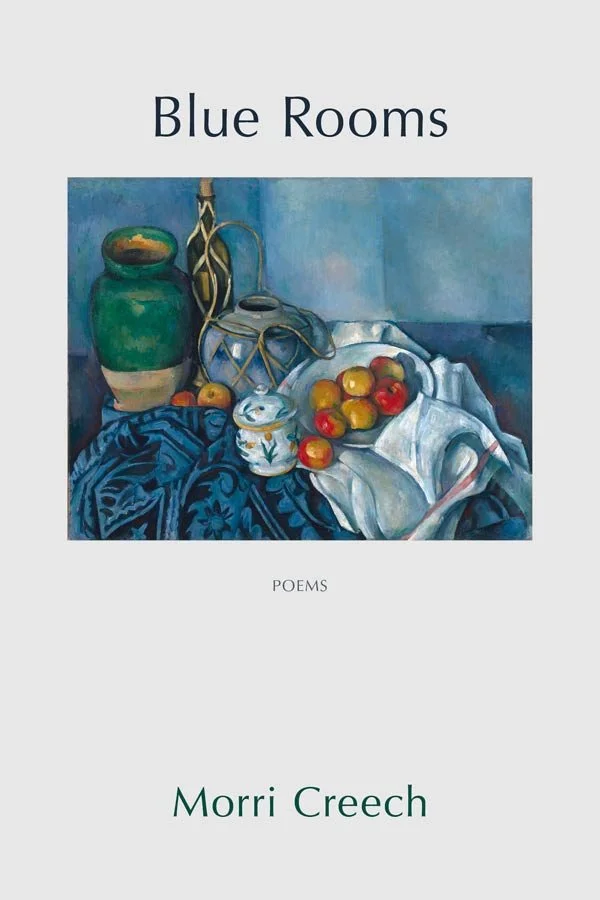
Blue Rooms
by Morri Creech
Pub: Oct. 15, 2018
Morri Creech’s eagerly awaited fourth collection of poems, Blue Rooms, explores the uncertain terrain between conscious perception and the objective world. It includes powerful lyric sequences that examine Magritte’s surreal investigations of the elusive self, Cézanne’s attempts to limn the dynamic nature of reality, and Goya’s unflinching depictions of cosmic and historical horrors—all of this while balancing rich language with the exacting formal control we have come to expect from this poet, whose last collection was a finalist for the Pulitzer Prize.
-
“In these poems, Morri Creech, one of our finest formal poets, confronts the fundamental mystery of language—the way the world is captured by and transformed into words. In the tradition of Wallace Stevens, he combines philosophical insight with eloquence and wit, as he marvels at how the mind is able ‘to conjure matter purely through perception.’” — Adam Kirsch
“Blue Rooms is a clear-sighted book, arresting in the beauty of its imaginative and linguistic artistry, but also in the elegiac power it wrings from the poet’s dead-level doubts about the whole idea of arresting beauty with imagination and language. Creech pushes these anxieties past conventional literary paradox into the realm of human consequence, till they open out, naturally, into a number of serial meditations that furnish the poet with occasions to ponder the limits of memory, experience, perception, and reality itself, all with his usual tact and acuity. Then, in the same book, Creech can turn around and give us, in a less speculative vein, ‘The Confession,’ a devastating monologue, spoken by one of the perpetrators of a lynching, that affirms the promise of good poetry as a spur to serious moral reflection. Morri Creech engages and challenges his reader, and himself, at the intellectual, philosophical, and emotional levels, and the result is a truly dynamic and remarkable book.” — Joshua Mehigan
“These lucid, elegant poems suggest an indebtedness to Wallace Stevens and Anthony Hecht, but it is primarily the late Howard Nemerov whose temperament and genius Morri Creech has so brilliantly rechanneled in Blue Rooms. Like his precursor, Creech attends to the everyday (what he calls ‘the modest raptures of the ordinary’) with grace and gravity, to move us ‘beyond the reach of language.’ This stunning, compact volume delicately leads us from the familiar to the infinite, blending together seamlessly the imagined and the real. I loved reading this book.” — Willard Spiegelman
"Situations in these poems are "ordinary," a man, say, at the start of a day, looking in a mirror, looking out a window, carrying out the trash, having a job, having a family, having a self, and wondering how it is doing, wondering what his future and his past and this day are; and writing about these things in beautiful expressive lines of verse, faithful measured lines with their varied subtle pressures and subtle cadences, responsive to the variety of pressures and cadences of the thoughts and feelings of the life being lived." – David Ferry
Poetry readers who have encountered Creech’s Field Knowledge and Paper Cathedrals will be intrigued by this third book.
-
Cézanne
1.
The man with brush and palette knife
Watches the gleaming light of Aix.
A scrim of cloud goes skimming by.
If it is a solitary life
To paint with brush and palette knife
The spheres, the cones, and cylinders
Of nature in a layered light,
Then this is the man and these the right
Structures and geometric shapes
To see things by. The colors shift
Beneath the essences distilled
Of mountain, orange, pine, or peach.
The world and his perception rhyme
On a canvas of arrested time.2.
An ancient sun has shed its blue.
Here the wind goes slow, then still,
Beneath a smear of deeper brown
On rooftops at the edge of town.
A balding man stands on the hill.
He sees the sea, shades it the hue
Of consciousness, with strokes of white,
One island like a far meringue.
To set things down the way they seem
And get the sullen colors right,
Shape of a woman’s folded hands
Or oranges wrapped in swaddling bands,
Those stray folds where the shadows start,
Are all his labor and his art.The Waywiser Press
The Confession
I could draw you a picture if I had a mind to.
Out past the last road there were woods and a still.There were cars in front of a ramshackle barn,
The moon in a cloud and a tree on the hill.I remember the raw December weather,
Boys shouting curses and most of them drunk.I remember the wind in the barley stubble.
I remember the man they dragged from the trunk.The moon appeared and disappeared.
Headlights and whiskey. A tree on the hill.We tied the knot and we threw it over.
It took half an hour for his legs to go still.Just boys, for all that, in December weather,
Settling a grievance, correcting a wrong.I remember one shoe kicked off in the heather.
I remember my feet hurt from standing so long.The place may be there. I could draw you a picture.
The moon in a cloud and a tree on the hill.Damned if I know how I see it so clearly.
Don’t ask me to speak of it. Damned if I will.The Waywiser Press
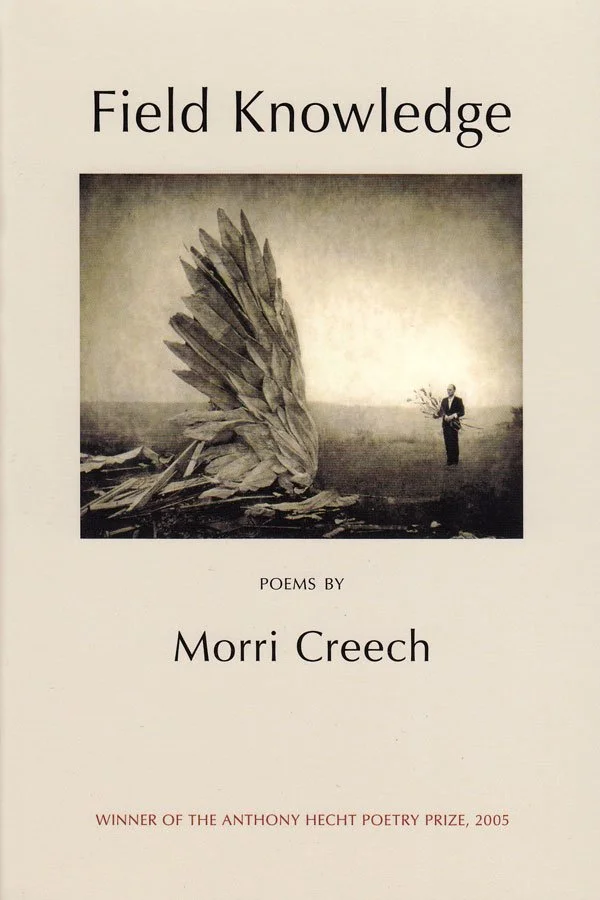
Field Knowledge
by Morri Creech
Pub: Oct. 12, 2006
Winner of the 1st Annual Anthony Hecht Poetry Prize
Foreword by the judge, J. D. McClatchy
Field Knowledge, Morri Creech's second collection, is a series of lyrical meditations on the limits and perils of knowledge, the beauty of experience and its inherent deceptions. Covering a breadth of subjects – from poems about his own family and the connections between local landscape and collective memory, to evocations of Giotto, Newton, and Primo Levi – Creech explores both the familiar world and its hidden mysteries. Many of the poems in this collection share with its predecessor an interest in theological subjects: here are dramatic monologues in the voices of Job and his wife, even an "Elegy for Angels". Other poems evoke both the mysteries and terrors of science, as when Oppenheimer first beholds "the radiant god, shatterer of worlds" in "In the Orchards of Science". Still others examine the cost of experience through a variety of historical and fictional characters, including Marvell's coy mistress, Simone Weil, and Rousseau. Ranging from the humorous to the elegiac, employing both free verse and structured formal stanzas, Creech's lush poems explore the sting of experience while luxuriating in "the honey of knowledge."
-
"Morri Creech’s Field Knowledge has given me more pleasure than any book I have read in years. The judges of the Anthony Hecht Poetry Prize clearly knew their business!" – Frank Kermode
“There are austere poets whose very distance from the world and whose reticent style create a tension that brings the experience described and the poem enacted into a sharper, more heartbreaking focus. And there are luxuriant poets – poets like Keats and Whitman and Hopkins – for whom the world’s bounty and the heart’s bottomless mysteries spill over into lines that almost burst with excess. Morri Creech is a luxuriant, but a canny one …
[H]e has made a book in which a reader can both lose and find himself. Field Knowledge is a rare achievement, and a lasting one.” – J. D. McClatchy, judge of the Anthony Hecht Poetry Prize, 2005 (from the foreword)."Morri Creech uncovers for us the world as unspeakable enigma … Each thing he holds up to the eye is lit from inside with the fire of its own passing away and its own eternity … These poems transform by a deepest magic." – Li-Young Lee
"Gorgeous as they are, these poems maintain a fine tension between earthly splendors and spiritrual anxieties. As a result, they never slip over the line into extravagance … Morri Creech’s language ‘forges its burnished imprint on the river’ of our own consciousness … [D]azzling." – Susan Ludvigson
"The biblical, as both testament and revelation, is important to this poet the way the mythical is vital to so many others. It is the informing adjective of his imagination and the modifier through which his personal world and the natural world are transformed … His writing fills with light" – Stanley Plumly
-
New Criterion , November 2006
"Winner of the first annual Anthony Hecht Poetry Prize, judged by Hecht’s literary executor, J. D. McClatchy, Morri Creech’s Field Knowledge has set the bar high for future aspirants … In a book centered on the pastoral, Creech weaves form into the delicate description of raw, Southern landscapes. He relishes the textured fields of his childhood and the layered histories that the land evokes.Creech spends much of the book unearthing these stories … but, over time, they seem to take a backseat to the process of recovery itself. In the title poem … Creech lifts, layer by layer, time’s influence on the summer soil: “as if you could prize from weeds and loam one immaculate/ hour, one orient pearl buried at the damp root, and lift it clear/ of the years of corn stalks, furrows, hay rakes freckled with scat – .” The fourth, and last, trochee, in a list that serves to relay the weight of the waste, “freckled” is the perfect word to describe Creech’s memories – sun-worn and spotted.
In the opening poem, “Engine Work: Variations,” Creech remembers his grandfather’s yard; he recalls “stripped engines” and “ripe fruit.” The poem begins with a sense of certainty – “June morning. Sunlight flashes through the pines” – but soon his stanzas deliver doubt: “Or else it’s late – September – .” Creech is uncertain: not only how to repossess the memory of his grandfather, but also whether poetry is capable of such an undertaking …
While Creech’s poetry also explores mythology and science, his personal poems (such as the two quoted here) make Creech’s doubts beautiful, memorable, and poignant. He makes the reader question his own past and the facility with which it can be restored. – Callie Siskel
Booklist
"Aptly enough, Creech’s second collection is the first winner of a prize named after the late Anthony Hecht, who with Richard Wilbur upheld the standard of formal poetry in the generation of American poets that came of age in the 1940s. There are a great many more formalists in or just ahead of Creech’s contingent (he was born in 1970), but perhaps none combines gravity and grace as he does. Those qualities are consciously and consequentially on his mind in the three poems constituting "Some Notes on Grace and Gravity," which consider how Giotto, Leonardo, and Newton, respectively, confirmed the interdependence of grace and gravity. The muralist draws the feet of holy figures to the ground, the painter-scientist turns from rendering saintly flesh to sundering cadavers, and the theoretician unites gravity and grace, mass and motion, materially. If those poems concern the infusion of the sacred into the profane, others mourn modernity’s willful alienation from the sacred, quite often by imaging gods in exile, as in the three poems, placed early, middle, and late in the book, about the travails of Orpheus. Besides such grave pieces, there is much that is witty. Throughout, there is a use of the European poetic tradition that is as gratifying and profound as it is assured. This man’s good." – Ray Olson (Copyright © American Library Association. All rights reserved)Antioch Review
"Field Knowledge is intelligent, remarkably dexterous and inventive in its use of form, and – line by line – often dazzling, like "the sprinkler’s lisp and hiss / trailing a veil of diamond through the air." The book is also playful, sometimes very funny – exploring, for example, angels whose heaven involves a trashy casino. Such gifts make Field Knowledge one of the strongest collections this reviewer has read in years." – Benjamin S. Grossman -
The Canto of Ulysses
Primo Levi, in his apartment in Turin, reading The Divine Comedy. February, 1987
Drowsing, head propped above the eighth circle,
he feels the present shifting like a keel,
takes his bearings by the toss and swivelof snow in window light – though still less real,
it seems to him, than that thick Polish snow
which, tumbling in his mind, begins to wheellike Dante's leaves or starlings, like the slow
stumble of shades from an open freight car,
or from an open book. All night, the snowwhirls at his window, whiting out the stars.
We sailed now for the stars of that other pole.
Leafing a thumb-worn page, he tries to parsethose lines he once struggled to recall
for a fellow prisoner, who'd hoped to learn
Italian as they scraped rust from the wallof an emptied petrol tank. The greater horn
began to mutter and move, as a wavering flame
wrestles against the wind and is overworn –although, oddly enough, the lines sound tame
now there is no one to explain them to.
Nor words to write. His own canticle of painis, after all, finished. The past is nothing new.
And the present breaks over him like the dream
of firelight, plush eiderdown, and hot stewa prisoner will sometimes startle from
who has lost hope of returning to the world,
blowing upon his hands the pluming steamof breath, in which a few snowflakes are whirled.
Or, nodding above the passage where Ulysses
tells how the second journey ended-hurledby a fierce squall, till the sea closed over us –
he feels at the moment like that restless king
home from Troy after twenty years, his facegrown old and strange from so much wandering,
who broods all night over the cyclops' lair
or Circe's pigs, the shades' dim gathering,then falls asleep.
He leans back in his chair.
It all seems now just like it seemed – the snow;
the frozen dead. They whisper on the stairas if he'd called their shades up from below
to hear the story of Agamemnon slain,
or paced out the long maze of the Infernoto hear their lamentations fresh again.
Beyond his window: stars, the sleeping town,
the past, whirled like flakes on a windowpane –the sea closed over us, and the prow went down.
Dreaming, he drops the book without a sound.The Waywiser Press
Listening to the Earth
after the photograph by Robert Parke Harrison
We'd heard the prophets speak,
knew well their eloquent thunder, the split stone
and urgent whirlwind of their voice and word,
had grown used to the fierce synaptic streaks
of flame, the olive-bearing birds
and withered fields that figured their concern.But what we'd never heard
was their silence: the wind grown inarticulate
at their retreat from us, the god's command
hushed in the trees – a voice they'd said had stirred
for our ears that we might understand
what now, plainly, none of us could interpret.At first we were relieved;
such talk of mystery and consequence
when there was work to do, laundry and errands,
the grain waiting for harvest. So we lived
unhindered for a while, our minds
less cluttered, clearer, fixed in the present tense.But who would read the hail,
storms and stars, the pale fever of winter sun
or those first harsh winds that flushed the moon's gold,
swept the corn and mellowed the plums each fall?
Who was there to say what the world
meant? The raven's flight, bees sweetening carrion,had little to do with us;
the sparrow's note was foreign to our ears.
Breezes stirred in the eaves much as before,
it seemed, but kept on saying less and less
about us. On the granary floor
the scattered chaff would not speak to our fears.It wasn't the god we missed,
but how a god might sound, those metaphors
and tropes that yoked us to some vast design,
threshing hidden shades up out of the mist,
or lilies that neither toil nor spin,
beneath a sky now strewn with random stars.And in the plain streets we listened
for those syllables that once conjured the cold,
fathomless swells of Leviathan-haunted seas,
the fabled bush ablaze on hallowed ground,
and snowflakes' mythic treasuries
transfiguring our ordinary fields.The Waywiser Press