
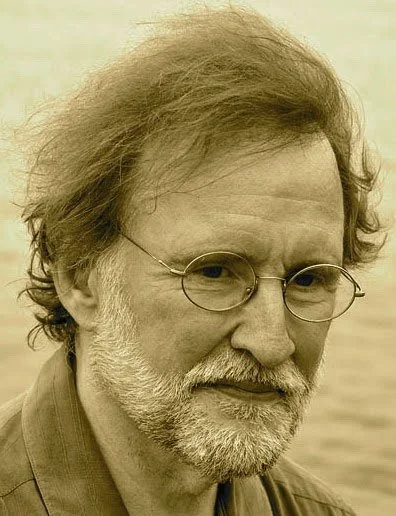
Kraushaar was born in Washington DC and grew up outside Boston in Concord, Massachusetts. He attended Marlboro College in Vermont, where he studied literature and writing, worked briefly as a high school English teacher, then as a cab driver in Boston. After this, he moved to London for two years and travelled in Europe. Back in the States he lived for a time in New York City and again in Boston. He attended trade school in Louisville, Kentucky, worked as a welder on the coal and grain barges on the Mississippi and then moved to the state of Mississippi, where he worked as a pipe welder at Ingalls Shipbuilding. He moved to Wisconsin after two years at the shipyard, worked in construction as a pipe welder but found this was “definitively not my dish” and so went to nursing school in Madison, Wisconsin. He has worked as an RN in Madison since the mid-80s. His work has appeared in the Hudson Review, Ploughshares, Alaska Review, Gettysburg Review, as well as Best American Poetry, and the website Poetry Daily. He has been featured in the Missouri Review as well as Michigan Quarterly and has been a recipient of Poetry Northwest’s Richard Hugo Award. A previous collection, Falling Brick Kills Local Man, was a finalist for the May Swenson Award, the Juniper Prize and the Walt Whitman Award, and was published in 2009 by the University of Wisconsin Press as winner of the Felix Pollak Prize.
Mark Kraushaar
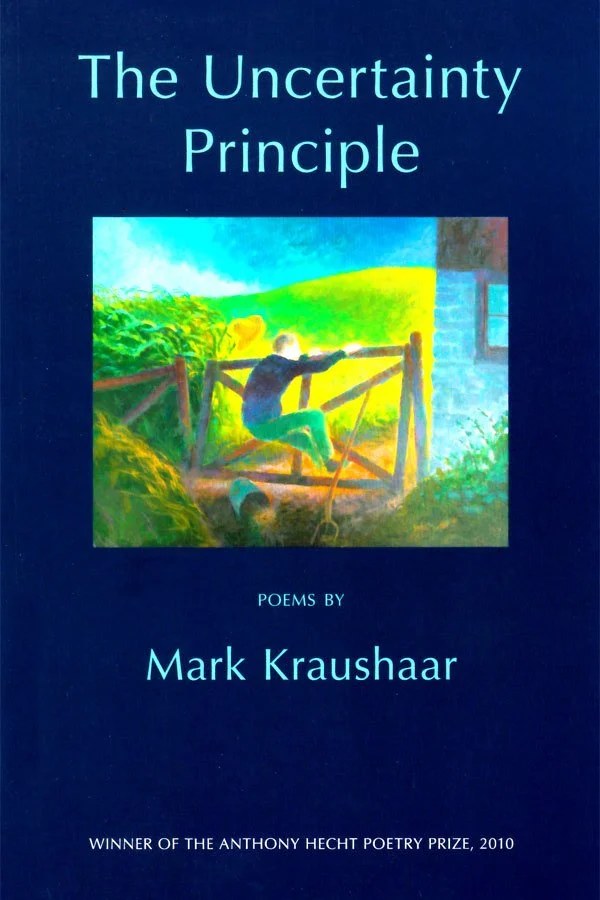
The Uncertainty Principal
by Mark Kraushaar
Pub: Nov. 8, 2011
Winner - 6th Anthony Hecht Poetry Prize
foreword by the judge, James Fenton
In his splendid new collection, Mark Kraushaar addresses a tentative and awkward, sometimes funny though frequently heart-breaking struggle to find a path to meaning in the world, a task made more difficult still by the struggle itself. In “Cake” a man arriving too late for his own small birthday party, unable to cajole his exasperated and saddened wife and daughter into staying, watches them exit the diner in which the three have met, then finally opens a book. As the waitress approaches, the narrator asks, “And what in Hell is he reading?” Towards the end of “Chiropractor Claims to Travel Through Time” (a poem inspired by an AP story), the central character observes of his father, “He tried, I know, / but every evening / watching him watch the tv / I wondered what clues had eluded him. / Constricted, uncontent, incomplete, / what secret had he missed?”
What People Are Saying
“Once a student told me her father said that when older people cry, they’re weeping because the world is beautiful – they already know it’s sad. Mark Kraushaar’s poems, too, look beyond the sorrow and find instead a world that’s almost unbearably lovely. I fell hard for Falling Brick Kills Local Man, Kraushaar’s first book; I have an even bigger crush on this one.”
– David Kirby
“A bell goes tolling over the landscape of Mark Kraushaar’s The Uncertainty Principle and its burden is Moment, moment … The word keeps recurring in this engrossing collection. Kraushaar sometimes seems temperamentally as much short story writer as poet (something to be regretted only by those who would keep poetry pure of life’s muddy complexities), and many of his poems offer rich, beguiling, abbreviated narratives. The book abounds in character revelations perhaps too modest to be called epiphanies – but moments, even so, whose unlikely glimmerings are welcome and illuminating.”
– Brad Leithauser
“Mark Kraushaar’s The Uncertainty Principle is the best counterargument to the specious claim that narrative poetry is either old fashioned, ‘linear’ or predictably ‘conventional’. These poems have all the excitement and complexity of life as we live it now, together with a depth of speculation that is positively stunning in the light it casts on the intimate nooks and crannies of social experience that all of us encounter but either fail to notice or find words for. The sensation of time is Kraushaar’s ultimate subject, but he approaches time so imaginatively, so freshly, through such a detailed range of voices and occasions, in poems that unfold in such surprising yet inevitable ways that one feels as if every other possible subject for a poem – love, death, the struggles of dailiness, the fear of loss, friendship and work, childhood, contingency, and lack of faith – has been woven into the netting of this one obsession. This is a book to be enjoyed and savored, to be read with pleasure and gratitude, to be learned by heart.”
– Alan Shapiro
Excerpts
Third Street Muscles and Fitness
It's rained all night,
and it's rained all day, and by evening
when I get to the gym it's started to thunder.
Still, here we are anyway, all of us, all the regulars,
George and Phil and Johnny B and Bob
and me and the big guy, the lifter from Janesville.
So first off George (who's zipping his coat)
asks Phil who's on the treadmill and the only
one raising a sweat will he run a mile
for every beer last night.
Which very funny, but Phil follows with, Hey,
I'm not drinking any more in '08
(beat, beat) but I'm not
drinking any less either which, again,
very funny except we all know Phil has
problems with alcohol, but since he's getting no laughs
he looks up and on the tv over the rowing machine
there's the real life trial of a woman, blond
and twenty-three, a teacher who's
had sex with an eighth grade boy.
Are you kidding, says George,
Are you kidding, says Phil, I'd clap her erasers,
and someone else, I'd polish her fruit,
and everybody's nodding yes and yes again
until, at last, George who's had problems with school
and problems with money and women and work
tells us he'd have majored in meredial reading
which is where the tv goes to an ad
and George waves once and steps into the weather.
So as the rainy wind flips his cheap rug straight
off his head like a flattened cat
it's strange, nobody's laughing, in fact, we're quiet finally,
Phil with his crashed marriage and the daughter
on drugs, and even handsome Bob
and Johnny B, even the big guy
with those silly disproportionate arms,
and for a moment, for a discrete, small portion
of what I will one day refer to as the past,
there's the five of us facing three
double-door sized panes
of rattling glass:
rain on the awnings, rain over the windows,
rain over the gutters and rain
in soft, sparkling ropes along the curbs,
and into the drains and under the ground.
The Waywiser Press
What The Dead Know
They know to keep quiet.
But they would tell you don't worry.
They would tell you there's
sloping gentle fields and a marvelous light.
They'd whisper, Mister,
take it easy, they would signal Madam, buy a hat.
They would tell you start again, rent a room, move
forward, breathe a little, read a little,
take a walk, watch your step.
They would tell you God
wears plaid pants, six-eyelet
oxfords, and a wrist watch, Helbros, gold.
They would tell you God's
a girl in third grade knotting Her shoe.
They would tell you God's a man with cracked glasses
mowing His yard, or He lives with Lilly,
His wife, and a son named Sal.
They would tell you He works in auto body repair
and plays the guitar.
They would tell you He's thought up Himself,
that He thinks up botany and basketball,
eczema, mustard, and mayhem.
They would tell you He makes up the malls
and the back-alleys, the droplets, and the tiny specks
and spores, and the long, loud parties
that reach deep into the morning and mean
for someone a meeting, for someone
a mating and for someone a crashed
yellow Chevy and a trip to the joint.
They would say He makes up the frowsy freeways
and the dirty everyday, or that regarding a white cloud
in the shape of a thumbless glove, He thinks up breakfast
with bacon that sizzles and curls on itself like a lie though He
may never speak of this even to Himself.
What do the dead know?
They've signed on to keep quiet,
but if they could tell you they would,
and if they could they would comfort you.
They'd tell you, Go on and be happy, try it.
You would.
The Waywiser Press