

Hannah Louise Poston
Hannah Louise Poston is a poet, essayist, and online content creator whose writing has appeared in several places, including Poetry Daily, Longreads, and The New York Times. She has an MFA in poetry from the University of Michigan and a BFA from the University of North Carolina at Chapel Hill, which she attended as the Thomas Wolfe Scholar in Creative Writing. Hannah has taught poetry and writing as the Writer-in-Residence at St. Albans School, at The Pennsylvania Governor’s School of the Arts, and at the University of Michigan, and she has taught Argentine tango in studios all over the country. For work she reviews makeup on YouTube and writes grants for climate activists. She is from the mountains of North Carolina and she currently lives in Maryland.
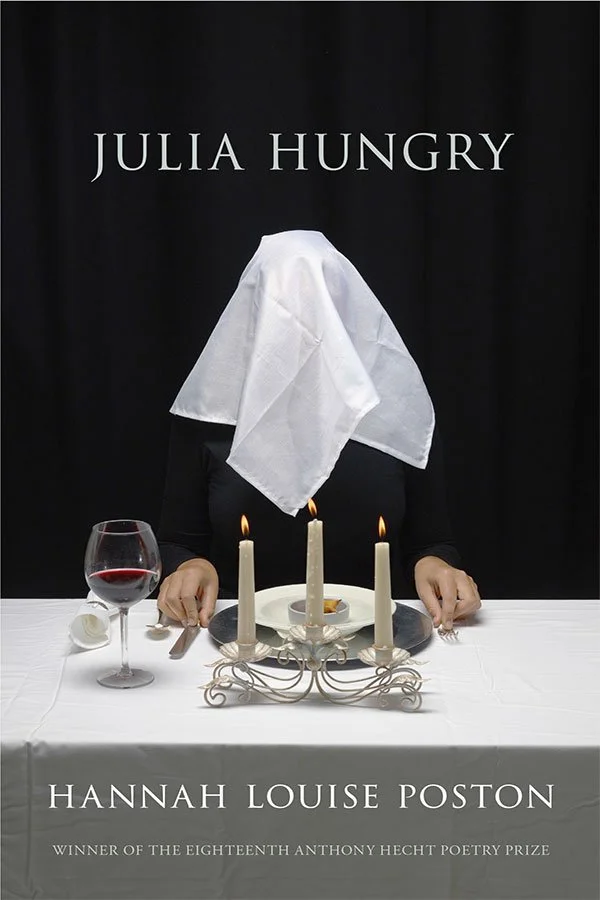
Julia Hungry
by Hannah Louise Poston
Pub: Mar. 12, 2024
Winner - 18th Annual Anthony Hecht Poetry Prize
foreword by the judge, Linda Gregerson
Julia Hungry is a communion and reckoning with form—a female poet’s apprenticeship to the male-dominated canon of twentieth century verse, part love-affair and part fencing match with its forebears. Inherited forms are intact almost to a fault but flooded with femininity as if in an attempt to rinse them out; in kind, the poems are laced with uneasy domesticity—a current of tension which begins inside the home and expands over the course of the book, eventually reaching a global scale. There, fully haunted by the music of the past, Julia Hungry peers into the future, asking questions about reclamation and survival.
What People Are Saying
“Pleasure is here aplenty in the pages of this marvelous debut, pleasure in the full spectrum of poetry’s musical and figurative enchantments. What keeps me coming back to the poems, however, is not only their lyrical accomplishment, impressive as that may be. No. What keeps me coming back is the amplitude and sheer good company of the author’s agile mind.”
— from Linda Gregerson’s foreword
“Julia Hungry is canny and powerful, but also hilarious and debased, in the way that undressing a body can reveal both erotic delight and the awkwardness of limbs. With a rare skill for poetic form, Hannah Louise Poston’s captivating debut reveals the monstrous—by which I mean the marvelous—lurking within the quiet spaces of the kitchen or the garden: ‘Womanhood reared / its ugly head,’ writes Poston, brilliantly; ‘head that doubles / each time it’s severed.’”
— Tung-Hui Hu
“Hannah Louise Poston startles her readers into understanding even their most basic perceptions newly—in the kitchen,” she writes, ‘it smells like old pears / as if a thumb pressed gently on the surface of the air / would poke a fissure through to warm rot,’ and one feels as if one for the first time understands smell. But perhaps more important than that particular understanding is the awareness of the unification of senses—in the simile, the sense of smell and the sense of touch—one derives from the lines. In Julia Hungry, Poston’s is a unifying vision—not naively so, but in response to a world of discontinuities. Julia Hungry is a healing book that makes its wound.
— Shane McCrae– Robin Oliveira (author of My Name is Mary Sutter and I Always Loved You)
“Not since Auden has pastiche been handled like this.”
— Jesse Nathan, author of Eggtooth
Excerpts
Julia Hungry
She reconstructs her ruptured orange peel
while telling me about the fancy meal
(such slick glass noodles, she could slip them down
without the use of teeth, and bloodless beets
no longer than a tea-fork’s tine, pellucid
silver wine, a piece of uncooked fish
in lemon sauce, so spare and colorless
it was completely imperceptible
against the platter’s ghostly porcelain,
and on her tongue it melted clear away—
she swallowed nothing). Pressed between her palms,
the bitter peel is seamless as shellac.
It’s empty and the orange won’t come back.
Hannah Louise Poston
In the Kitchen
in the kitchen it smells like old pears
as if a thumb pressed gently on the surface of the air
would poke a fissure through to warm rot
it seems the year is all sockets of rot
the kitchen smells like tinny pots
and time is an old fork and an old knife
the empty fridge is full of vacant stares
the kitchen piled high with old pots
and rusted pans with circles stacked on squares
and time is falling down the stairs
the kitchen clock is mounted on the air
as if the kitchen walls are barely there
and time is a pear full of soft spots
the knives and forks are scattered there
as if awaiting routine repairs
and time is not and time is not
the kitchen smells as if it wasn’t theirs
the rot smells like kitchen pears
and time is sitting quietly in chairs
the kitchen isn’t there or isn’t theirs
or if the kitchen is then they are not
Hannah Louise Poston