

Greg Williamson
Greg Williamson grew up in Nashville, Tennessee. His first book, The Silent Partner, was published by Storyline Press and won the Nicholas Roerich Prize in 1995. His second book, Errors in the Script, was published by Overlook Press in 2001 and was runner-up for the NYC Poets’ Prize. He has received a Whiting Award, an NEA grant, and an Academy Award in Literature from the American Academy of Arts and Letters, among other honors. He teaches in The Writing Seminars at Johns Hopkins University.
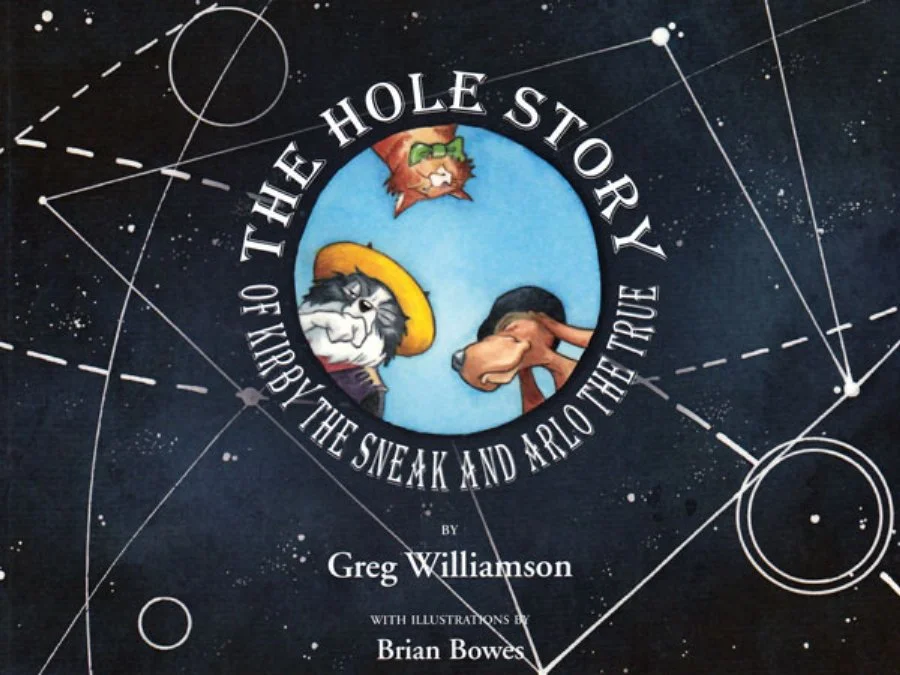
The Hole Story
by Greg Williamson
Pub: Aug. 6, 2015
Illustrations by Brian Bowes
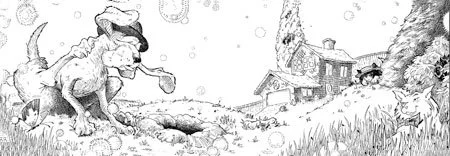
When Kirby the sneaky, dog-genius steals the hole Arlo dug in the yard, social order begins to break down. The ants get lazy. The brook dries up. The dragonfly has engine trouble. Kirby faces grave, injurious peril in getting it back and restoring cosmic harmony. Reflecting upon the hole’s eerie influence, he contemplates spider webs, Newton, The Old West, Scottish history, Templars, the Roundtable Knights, the existence of dragons, and the nature of time, itself, on the way to devising his Theory of Something, The Downhole Effect.
The award-winning author of The Silent Partner, Errors in the Script, and A Most Marvelous Piece of Luck is once again at the top of his game in this wickedly inventive, dazzlingly written and uproariously funny book.
-
“Greg Williamson can do anything. A 1,200-plus-line narrative poem? Child’s play. About a dog that filches another dog’s beloved hole, then returns it? You betcha. In rhyming couplets? Ayup. That manages, improbably, to morph into a profound and startling meditation on genealogy, Chaucer, and the nature of space and time, among other subjects? Absolutely. And all this he manages while showing off an astonishing combinatorial agility and playfulness, laying waste any distinction between so-called high and low diction, so-called high and low ideas. In The Hole Story Greg Williamson once again demonstrates that he is a writer as metrically and intellectually nimble, as witty, and as line-by-line delightful as we have – or might hope to have – in American poetry.” – Michael Griffith
“You may not think that you’ve been impatiently waiting to read about slinking Kirby and put-upon Arlo, two versifying mongrels, but I assure you that you have. It has been ages since a children’s poem showed this degree of polish, of unforced and uncloying smarts and brio and wit. The rhymes are so nimble! The pratfalls so spectacularly poised! The Hole Story is a true book-lover’s book – and an easy-to-swallow antidote to all those cyber-poisons that imperil our children. It’s long and loopy and cartoony and somehow concludes with a gorgeous, noble Hymn to a Suburban Afternoon. It belongs with Jarrell’s The Bat-Poet and Eliot’s Practical Cats and de la Mare’s Peacock Pie and Stevenson’s Child’s Garden of Verses. Those fun-loving gentlemen would companionably move aside and make room, welcoming Williamson to their sparkly table. You should too.” – Brad Leithauser
-
Kirby the Sneak and Arlo the True
Lived with the Burbles at house 42.And Arlo the True, Arlo van Guard,
Watched over his everyday things in the yard,His fir tree and fuzzball, his wetbowl and bone,
And Kismet the Catdog, who slept on a stone,And out in the yard by a uniform mound
His cherished, cool, dug-up-down hole in the ground.(He’d looked in his heart back when he was pup
And dug it a downhole instead of an up.)He watched over everything just to be sure
That his wherearetheys all were still there where they were.Now, Kirby the Sneak, Kirby Manchu,
Of a thousand disguises, unbeaten at Clue,Dogma Cum Laude from Trickery U,
Kept a keen eye on said Arlo the True.At the edge of the yard, past the reach of the law,
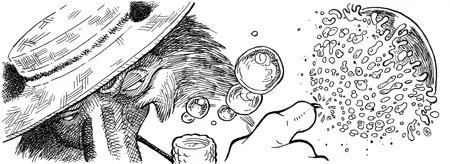
He drew on his drawpipe; he peered at his paw.He drummed with his nails. He rocked in his chair.
He twisted his whiskers and stared into air.And from under the brim of his sneaky slant hat
He schemed on the bowl and the bone and the cat.˜
What game could he play, what ruse could he do,
To bamboozle the scrupulous Arlo the True?He could flip the bowl over to look like a lid
So Arlo would wonder what was it it hid.He could bury the bone by the Burbles’s brook
That sluices through shadows where sleuthhounds won’t look.He could stuff the ball into a knot in the oak
As Phase One of a bigger, more practical jokeThat would take some straw, bungee cords, clipboard, a box,
And some UPS browns, with the Baden Powell socks.More from The Hole Story
But out in the garden the katydids trilled,
The trilliums waved and the woodpecker drilled,And Kirby the Sneak stroked his long, sneaky chin
And blew a big bubble and soaked it all in.The air grew more still. The hummingbird stopped.
The cat raised an eyebrow. The soap bubble popped.And that’s when it came to him, out of the blue,
A novel new way to trick Arlo the True;He laughed in his dewclaw just thinking it through:
He’d steal the downhole. Then he’d bury it, too. -
Brian Bowes received his Bachelor of Fine Arts in Illustration from the California College of Arts and Crafts in San Francisco, California. Currently he is enrolled in the Hartford University MFA in Illustration program and scheduled to graduate in 2016. He has illustrated numerous books, which can be found in bookstores, and in university libraries around the world, as well as in the Rare Book and Special Collections Division of the United States Library of Congress.
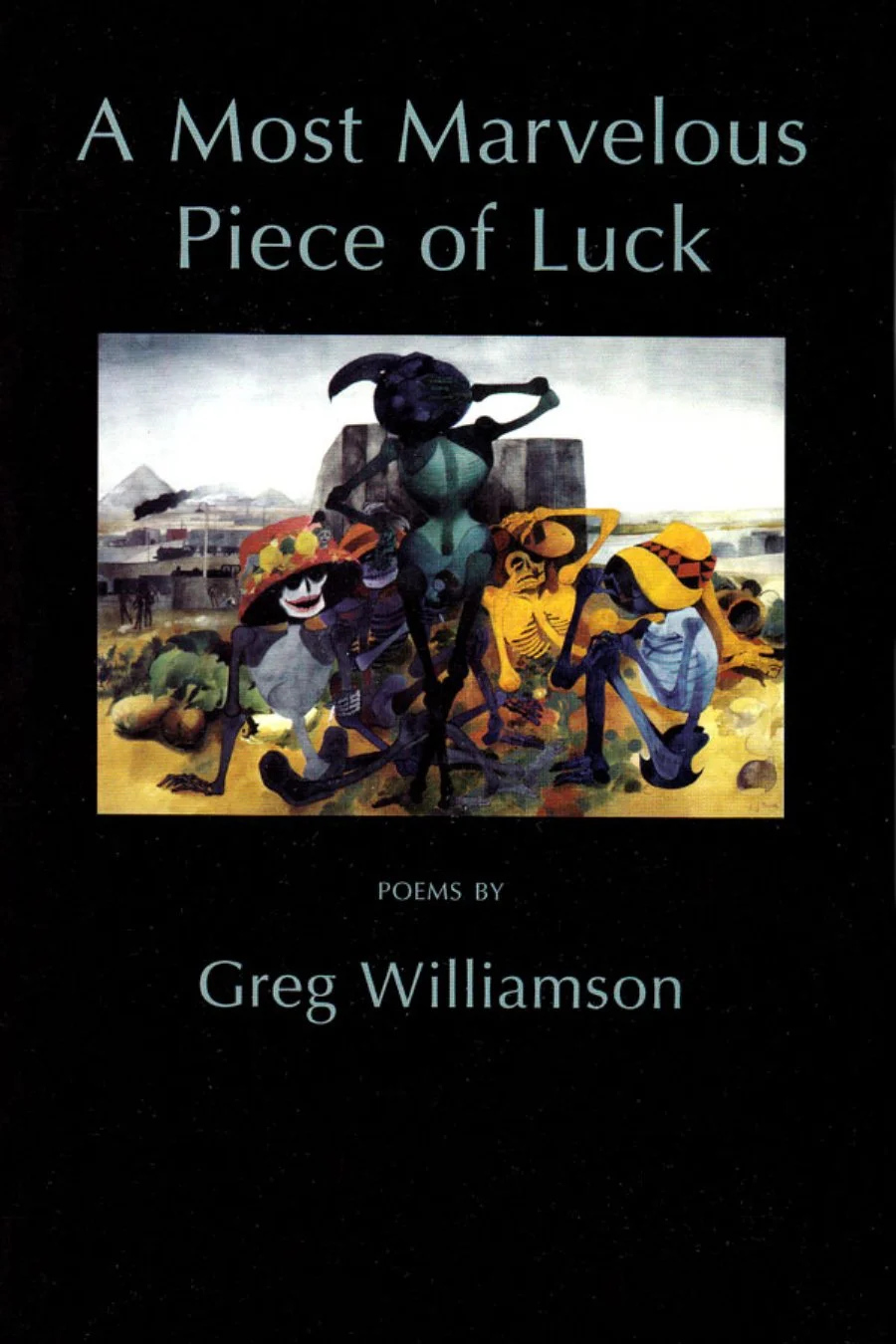
A Most Marvelous Piece of Luck
by Greg Williamson
Pub: Jul. 3, 2008
Set up rather like an encyclopedia, and containing urgent information about pretty much everything – from the Big Bang to the second shooter on the grassy knoll – Greg Williamson’s A Most Marvelous Piece of Luck is a collection of sonnets unlike any other.
The main character, an unnamed Everyman – a salesman, a poet, a conspiracy wonk, “the last man left alive” – a (somewhat) loveable loser, gets knocked off in the ninth line of every entry and is thereby condemned to being “old-fashioned, out of step, passé” for the duration.
Though full of science, A Most Marvelous Piece of Luck is anything but forbidding, and though full of dead people, and inescapably dark, it also manages, somehow, to be hilariously funny.
The award-winning author of The Silent Partner and Errors in the Script is at the top of his game in this wildly inventive, formally spectacular and hugely accomplished book.
-
“Anyone who’s read Greg Williamson’s previous books has been necessarily astonished by this poet’s intellectual scope, wicked humor and truly stunning formal virtuosity. His books, The Silent Partner and Errors In The Script have placed him at the lead of younger poets writing in America today. But apparently that’s not good enough for him. In his wildly ambitious and satisfying new collection, A Most Marvelous Piece of Luck, Williamson literally takes on the universe – the sun, moon, stars, the great unknowns of space, evolution, procreation – you name it. This poet’s got an opinion. And in a sonnet sequence no less! But these aren’t in any way your grandma’s sonnets – these are contemporary rhythms that feel utterly relevant while reminding us that music is still the pulse-quickening essence of poetry. What an extraordinary accomplishment this book is. In case you were wondering, the bar has definitely been raised.” – Erin Belieu
“The sonnet in English, which has changed only incrementally since Wyatt passed off Petrarch’s sonnets as his own, metamorphoses further with Greg Williamson’s brilliant inventions. I imagine a time when his particular form of the little song may even take on his name and be added to the distinguished list: the Petrarchan sonnet, the Shakespearean sonnet, the Miltonic sonnet, the Williamsonnet. I mean it. And this sequence deserves to take its place with the best.” – Mark Jarman
“Who ever would have thought that so many sonnets could still be so much fun? From birth to death, from the self to the cosmos, Greg Williamson’s energetic sequence takes us on a roller-coaster ride through the external and internal universe. Along the way he updates and invigorates the form of the sonnet itself. Like the range of his subjects, his diction winds, bends, lurches, and leaps from the scientific (‘thermohaline,’ ‘foraminifers,’ ‘isobars’), to the accurate but fanciful (‘Snood, Shako, Tam-o-shanter, Shriner fez’), to the invented (‘enrichum lawyericulum,’ ‘golfonaut,’ ‘blingblingitis’). The poems amuse, impress, and finally dazzle us. Williamson may often seem drunk on language, but he is always sober in his thinking. He takes an ordinary phenomenon like water, or a hat, then finds an appropriate cliché (‘we’re all wet,’ ‘under your hat’) and plumbs both of them, expanding, opening them up, looking at them anew. Words are his materials, and he uses them like a master craftsman. Out of carbon he makes diamonds.” – Willard Spiegelman
-
New York Review of Books, March 10, 2011
"The impulse to create a stylistic tour de force can lead easily to wayward literary pilgrimages … It’s a danger Williamson largely circumvents through sheer cleverness: there’s an extraordinary amount of wit and wordplay – outrageous puns, fractured homilies, garbled quotations, double entendres – in his short book.A Most Marvelous Piece of Luck recalls those planetarium shows that, in their vertiginous final minutes, whirl the audience through the cosmos …
Cleverness of this high-flying sort can transport a book … quite some distance, but on its own probably would be insufficient to make A Most Marvelous Piece of Luck the success that it is. The book holds up so well, richly repaying rereading, because there’s a somber, eerie iciness at its core. Human mortality is the grim, presiding overseer of these sixty-nine sonnets … These poems have a genuine touch of timor mortis conturbat me … the phrase from the Latin Office of the Dead that appears as refrain in a number of English medieval poems.
The cartoonlike aspects of A Most Marvelous Piece of Luck reassure us that everything is altright. In the Land of Animation, you can fall off a towering cliff or be flattened by an anvil, sizzle in a bolt of lightning or be encased in a block of ice, and no harm is done; nothing is more comic than indestructibility. And nothing’s more tragic than perishability. Timor mortis … Readers of A Most Marvelous Piece of Luck – this, yes, marvelous book – are now and then disturbingly aware that behind its jokes is an apparition whose skeletal smile is no joke at all." – Brad Leithauser
Able Muse, Winter 2008
"I am grateful to Williamson for his wit, his technical gifts, his vitality – and also his willingness to experiment. The poems [in this book] contain, just like his early volumes, numerous examples of lines that lodge themselves in the reader’s mind thanks to their witty deftness and lyrical elegance …Perhaps what is most striking is his ability to marry a gift for witty concision with a sense of imaginative openness; the phrases strike one for their pithy pointedness and then expand in the mind thanks to their evocative and suggestive power. A fine example is his neat encapsulation of the history of mankind after the discovery of fire in the first quatrain of the sonnet entitled “Fire”:
Imagine that first fire, the doubletakes
Among the vegans, cold, dark wet: Cave guy
Strikes flint and, boom, you’re grilling mammoth steaks,
You’re holding hands, you’re hooking up, you’re dry…A lot of history there: anthropological, social and scientific; and all got across with laconic humour and colloquial sharpness.
An even pithier example of concentrated meaning can be found in the first four words of the very first sonnet in the book, “Time”:
Time was, it wasn’t.
From this abrupt opening, the reader feels assured of an invigorating if occasionally bewildering journey. And Williamson certainly does not disapppoint. While I doubt I will ever fully understand all the poems, I know that I will continue to return to them and to delight in the riches of what he refers to in one sonnet, with comic self-deprecation, as the ‘enlaced rhyme’s lamentable, loony verse’. And I can’t wait to see where Williamson goes from here." – Gregory Dowling
To read the whole of Gregory Dowling’s lengthy article, please click link: Read whole article
The Yale Review, Fall 2008
“[A]mong the canniest and most nimble-witted of American poets … Williamson, whose previous collection, Errors in the Script, demonstrated his powers of tour-de-force formal invention … here creates his own sonnet form … Science, technology, sports, politics, music, social satire, nautical history, pop culture: such far-flung realms of thought and language jostle each other in a democracy of tropes, frequently within a single poem … Williamson’s wild inventiveness – formal, linguistical – would be a trap for lesser poets, his masks at times so elaborate and seamless that only a poet of the first order could speak affectingly through them. When on his game, which he is most of the time, Williamson manages to do just that. His dazzling poems leap from the ludic to the mordant and back." – David YezziTimes Literary Supplement, 12 September 2008
“In the Oxford Book of Light Verse, apart from the reminder that light verse is ‘serious’, W.H. Auden identified three kinds: that for performance, nonsense poetry and that ‘having for its subject-matter the everyday social life of its period or the experiences of the poet as an ordinary human being’. In today’s multicultural environment, this last can be an elusive precondition, but Williamson succeeds brilliantly as he plunges shamelessly into the aspirations, foibles and failures of Middle America, using the second-person singular … so that the voice gathers an inclusiveness about it and the satirist avoids being hoist by his own petard … [A Most Marvelous Piece of Luck] is almost like an emblem book, a diamond etched series of satiric plates with the sonnets as sharp morals, the acuity given by the language which ranges from a streetwise ‘hey, dude’ argot to po-faced definition. With its adventurous inventions, this is a marvellous piece of work." – N.S. Thompson -
Time
Time was, it wasn’t. “Then,” a singularity,
Planck’s constant, quantum foam, the bottom quark –
Better let them tell it – and, presto, we
Had time. Thus, gnomons, Stonehenge, Harrison’s clock.Time had a future. Time was in! And you
Could make it, save it, spend it, even un-
derestimate it (time is money, son?
Sure, but this ain’t the time your father knew)Until your limo slides up to the high
Society grand ball, everyone’s there,
Tripping the tarantella (“merci, with lime”),
The old soft shoe, high hat, a final air
Under the Milky Way, the signs, the sky-
light’s stars, where everything is done
in time.The Waywiser Press
Space
Space dons Time’s Delta pin. First date. Sparks fly.
There’s chemistry, there’s calculus, there’s luck.
And then (and there) there’s us, the loinsome fry
Of good old Father Time and Mother Fuck,Their spacey, new-age offspring, have her face,
His hands, cut from the same cloth, their heirloom.
We’re graviton, Calabi-Yau. We’re Space
And Time’s. We’re leg-, head-, elbow-, living room,Until one day there’s no room left of you,
Down in the module in your last space suit,
Doing some fieldwork in that dusty place –
Wormholes, dark matter, phase – a firsthand view
Under the Fox, the Swan, the Herdsman’s boot,
The Works, where Time keeps keeping time
with Space.The Waywiser Press
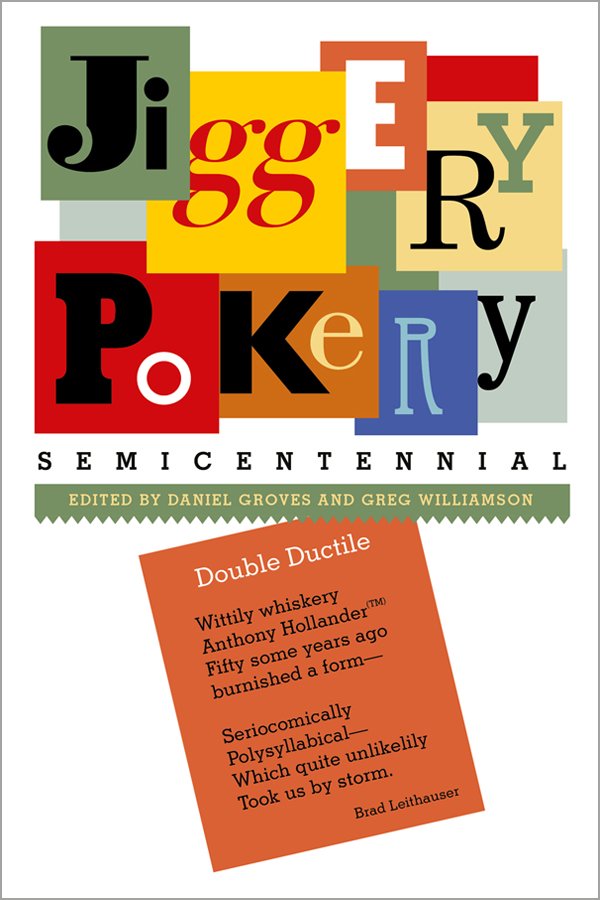
Jiggery-Pokery Semicentennial
edited by Daniel Groves and Greg Williamson
Pub: Mar. 15, 2018
Introduction by Willard Spiegelman
It is 50 years since Atheneum published Anthony Hecht and John Hollander’s Jiggery-Pokery, a compendium of verses known as double dactyls. The double dactyl was the invention of Hecht and Paul Pascal, and is was aptly described on the jacket of Jiggery-Pokery as a devilish amalgam of rhyme, meter, name-dropping and pure nonsense. It caught on, too, just as the limerick and the clerihew had caught on, and has been testing the mettle of many a poet — and not a few aspiring poets — ever since. To celebrate Jiggery-Pokery‘s half-century, Waywiser is delighted to be publishing Jiggery-Pokery Semicentennial, a wholly new compendium expertly edited by Dan Groves and Greg Williamson. The volume is dedicated to the memories of Hecht and Hollander, and it comes with a splendid introduction by Willard Spiegelman, Hughes Professor emeritus at Southern Methodist University in Dallas, and a regular contributor to the Leisure & Arts pages of The Wall Street Journal. Spiegelman’s most recent books are Senior Moments: Looking Back, Looking Ahead (2016) and If You See Something, Say Something: A Writer Looks at Art (2016). The volume also comes complete with a cover by the celebrated graphic designer Milton Glaser, a singularly appropriate choice since Glaser (still going strong at the age of 88) designed the cover for and also illustrated the original Hecht-Hollander volume.
-
"Think of ‘light verse’ not as mere triviality but as a special form of illumination. The double dactyl makes its own claims, and does its own work. It has grown over time. Take a look at [Jiggery-Pokery Semicentennial]: you will find God’s plenty, wittily miniaturized. The new double dactyls collected by Messrs. Groves and Williamson prove individually and collectively that having once ‘learned’ the rules of the form, a poet may produce a learnèd work, a poem both ‘simple, sensuous, and passionate’ (Milton’s desideratum) and playful, witty, even intellectual … The poets in these pages have extended the boundaries of Hecht and Hollander’s original definitions, and of their anthology of half a century ago. One hopes that the old masters would have approved … Contained in this slim volume, readers will find poems that are didactic, secular, witty, and ironic, as well as illuminating: often sensuous and passionate, perhaps even simple. Their illumination comes, in fact, from their didactic wit. — from Willard Spiegelman’s introduction
Jiggery-Pokery Semicentennial is the successor to the 1967 anthology, edited by Anthony Hecht and John Hollander. Published by Atheneum, the original Jiggery Pokery collected examples of a new poetic form that made its publishing debut the previous year in Esquire magazine. Setting something of a craze for those younger poets still seduced by the pleasures of formalism, the double dactyl was devised over a long lunch at the American Academy in Rome, 1951. Attendant on the scene were Anthony Hecht, the classical scholar Paul Pascal, and Pascal’s wife, Naomi. … The Semicentennial’s editors, Daniel Groves and Greg Williamson, are to be praised for bringing so many fine poets together in one volume. It is particularly pleasing to see a contribution from Chris Wallace-Crabbe, who also contributed to Hecht and Hollander’s anthology. I will close with one final double dactyl, by the late J. D. McClatchy, which rather beautifully manages to pay tribute to a Romantic writer without abandoning the essential mischievousness of the form:
Von Hofmannsthal
Higgledy-Piggledy
Hugo von Hofmannsthal
Wrote hushed libretti for
Noisy Herr Strauss,Radiant fables that
Incomprehensibly
Lifted the spirit and
Brought down the house.As it happens, those last two lines are also a fair descriptor for reading Jiggery-Pokery Semicentennial itself. — Andrew Neilson, The Hopkins Review, 12:2, Spring 2019
-
Male Gaze
Jiggery-Pokery
Orpheus Porphory
What were you thinking then,
Turning your head?Love is perdition that
Eurydicedingly
Lingers in hindsight: she’s
Better off dead.— Kevin Craft
Humperdinck
Pat-a-cake Pat-a-cake,
Engelbert Humperdinck
Didn’t sing pop songs or
Pump Heavy Metal.Though such a fact may seem
Contra-indicative,
He wrote an opera:
Hänsel und Gretel.— John Fuller
Von Hofmannsthal
Higgledy-Piggledy
Hugo von Hofmannsthal
Wrote hushed libretti for
Noisy Herr Strauss,Radiant fables that
Incomprehensibly
Lifted the spirit and
Brought down the house— J. D. McClatchy
Double Ductile
Wittily whiskery
Anthony Hollander(™)
Fifty some years ago per-
fected a form—Seriocomically
Polysyllabical—
Which quite unlikelily
Took us by storm.— Brad Leithauser
The Waywiser Press