

Clive Watkins
Clive Watkins is a poet, translator and critic. His first collection, Jigsaw, was published by Waywiser in 2003. Little Blue Man, an extended poem, appeared in 2013 (Sea Biscuit Press). In 2014 Waywiser published his second collection, Already the Flames, a Times Literary Supplement Book of the year. In 2018 he won the Robert Graves Poetry Prize. A further collection, Pedic’s Dream, was published by Common End Press in 2021. In 2022 he was a prizewinner in the John Dryden Translation Competition for translations from Eugenio Montale’s Le occasioni. His critical writings encompass poets as diverse as Conrad Aiken, Wallace Stevens, Eugenio Montale, Edward Thomas, E. J. Scovell, Robert Mezey and Michael Longley. He and the late Joseph Harrison were Waywiser’s first editorial staff, appointed in 2004.
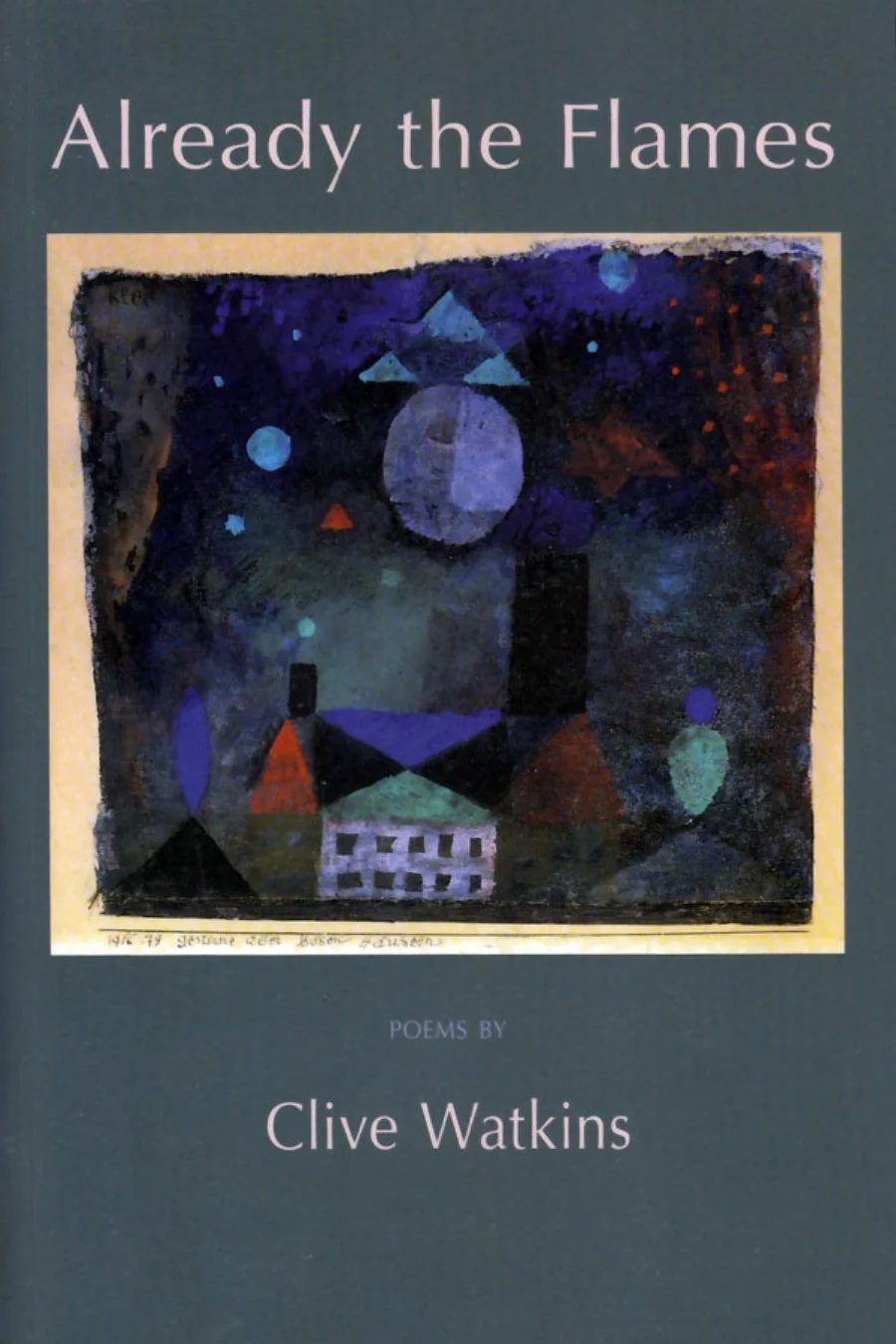
Already the Flames
by Clive Watkins
Pub: Oct. 9, 2014
Times Literary Supplement, Book of the Year
Clive Watkins's powerful second collection is by turns sensuous, sombre, lyrical and discursive. Already the Flames explores the position of those complicit in suffering or compelled to observe it in a world that appears ruled by malice or chance. The early sections are shadowed by the figure of Apollyon, the demon who attacks Bunyan's pilgrim. Hauntings, entrapment and escape are themes that weave in and out. The book moves towards an ambiguous release in the realm of the personal. The collection is remarkable for its formal range: poems, and sequences of poems, in free verse, in prose and in rhymed and unrhymed metres of various kinds. There are also several idiosyncratic and fluent translations. In Already the Flames Clive Watkins fulfils the expectations created by his first Waywiser book, Jigsaw, of 2003.
What People Are Saying
“This is arresting writing, each phrase alert and poised in a world where the tectonic plates have shifted and the surfaces we have to navigate are increasingly uncertain. It is good to be able to cross them in language that has the measure of the risks.”
– Roger Garfitt
“Clive Watkins is a sharp observer with a painter’s eye and piquant erudition, leading us both inward and out to where ‘A foreignness begins’. A long sequence like ‘The Angel’ spills the blood of historical and mythical consciousness, while a short poem like ‘Conversation’ nearly contains a novel in its implied drama. There are secret histories, oblique narratives in these poems, incised as much as written, darkly reserved and beautiful.”
– David Mason
“Clive Watkins’s second book of poems is a profound, moving, in many ways disturbing collection that asks to be read several times before it yields up keys to its import. One key is the poet’s mastery of suggestive language in which an undefined threat slips in and out of the book’s eight sections. Another is the impossibility of burying the still extant past under the bustle of the present. The book as a whole gives an impression of deeply felt experiences and personal relationships transformed by a brilliant, semi-abstract artist into poems like pictures and exhibited in an intriguing series of galleries. Having visited them once, I wanted to go back and visit them again and again.”
– Anne Stevenson
ExcerptS
Insignia
To give up pretensions is as much a blessing
as to have them gratified:
the act should be its own reward,
the knack of purposeful attention
that arms us against the dread of not existing.
It is for this reason, you say,
we must lay titles aside, insignia of rank,
the repertoire of prophylactic ornament.
Establish, therefore, a clean point of origin,
each new position thereafter
an evolution not to be denied.
But the anguished lust to return,
to make present the histories we have lived,
turns into fiction whatever it lights on.
Let these, then, be proxy:
at your throat a choker of black beads,
your ear-lobes weighted by these ebony drops’
all but weightless weight.
The Waywiser Press
Children Running Beneath Trees
Their naked shoulders mottled with green shadow,
they scatter beneath the tall September trees
down lanes and byways silent for their passing.
Closed the shutters, closed the familiar doors;
on iron balconies only a light breeze stirring
and sticks that rattle in unwatered pots.
Where are they running to, these skinny children?
Their bare feet pattering on the hard dry earth
send up small clouds of white dust in their passing.
They run with arms outstretched, but no embrace
awaits them in these desolate yards and gardens,
for of those who would take them in not one remains.
They make no cry, though their eyes are full of anguish,
as they hurry on through the early evening light,
which slides across the walls where they are passing.
(Don’t ask, my dear, what they are running from.)
And singly, now, in twos and threes, they vanish
through a fence, a doorway, behind the deserted school,
and, weight and substance lost, their blank hurry
is air, is empty motion, is nothingness,
as if some hurt had passed with their swift passing.
Then on the street the unremembering lamps,
fluttering moths, gleam of shuttered windows;
and in the rooms the stricken talk goes on.
September 2004
The Waywiser Press